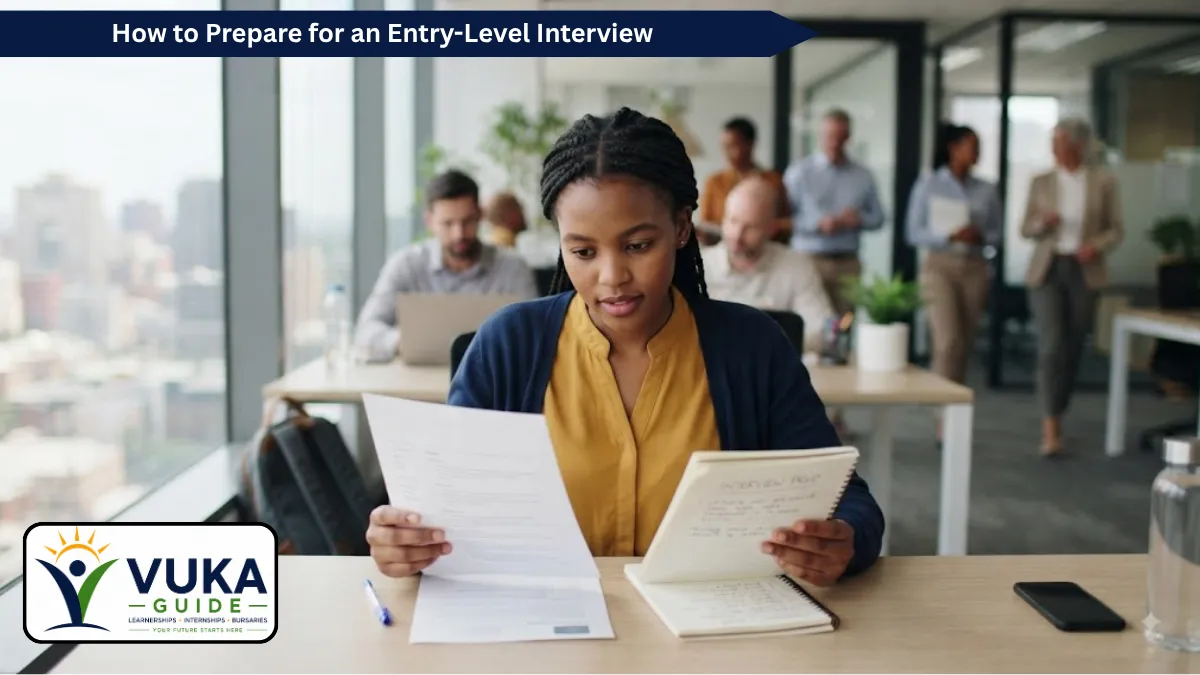
Getting invited to an entry-level job interview is an important step, especially if you are applying for your first job after completing school, college or university. While you may not have years of work experience, employers can still assess your communication skills, attitude, preparation, reliability and willingness to learn.
The good news is that interview preparation does not have to be complicated. By researching the employer, understanding the position and practising common questions, you can walk into the interview feeling more prepared and confident.
Quick Overview
| Interview Preparation Area | What to Focus On |
|---|---|
| Employer research | Understand what the organisation does |
| Job description | Know the duties and requirements |
| Common questions | Prepare clear, honest answers |
| Your CV | Know the information you submitted |
| Skills | Identify your strongest relevant skills |
| Documents | Keep requested documents ready |
| Interview outfit | Choose neat, appropriate clothing |
| Travel or technology | Plan your route or test your connection |
| Questions for the employer | Prepare 2–3 sensible questions |
1. Research the Employer Before the Interview
One of the easiest ways to demonstrate preparation is to understand the organisation you are applying to.
Visit the employer’s official website and learn about its products, services, customers and main activities. You should also understand the department or business area connected to the position.
You do not need to memorise the entire company history. Instead, aim to answer questions such as:
- What does the organisation do?
- Who are its customers?
- What industry does it operate in?
- Why are you interested in working there?
- What attracted you to this particular position?
This knowledge can also help you give more specific answers during the interview.
2. Read the Job Description Carefully
Before the interview, go through the job advertisement again.
Pay attention to the listed responsibilities, minimum requirements, qualifications, technical skills and personal qualities.
For example, if an entry-level customer service position requires communication, computer literacy and problem-solving, think about situations where you have demonstrated these abilities.
Your examples do not necessarily have to come from previous employment.
You can use experiences from:
- School or university projects
- Learnerships or internships
- Volunteering
- Community activities
- Student organisations
- Part-time work
- Group assignments
- Sports or other structured activities
The important thing is to explain what you did, what you learned and what the outcome was.
3. Prepare for Common Entry-Level Interview Questions
You should expect some questions to appear frequently in entry-level interviews.
Examples include:
“Tell me about yourself.”
Keep your answer relevant to the position. Briefly explain your educational background, relevant experience or activities, key skills and why you are interested in the opportunity.
Avoid telling the interviewer your entire life story.
“Why do you want this job?”
Connect your answer to the position and organisation.
For example, you could explain that the role matches your qualification, gives you an opportunity to develop practical skills and interests you because of the organisation’s work.
“Why should we hire you?”
Focus on the value you can bring despite being an entry-level candidate.
You could discuss your willingness to learn, reliability, communication abilities, relevant qualification and ability to work with others.
“What are your strengths?”
Choose strengths that are relevant to the position and support them with examples.
Instead of simply saying, “I am hardworking,” explain how you demonstrated responsibility in a particular situation.
“What is your biggest weakness?”
Choose a genuine but manageable area for development and explain what you are doing to improve it.
Avoid presenting a serious requirement of the job as your weakness.
4. Use the STAR Method for Behavioural Questions
Some interviewers may ask questions such as:
“Tell us about a time when you worked as part of a team.”
A useful way to structure your response is the STAR method:
S – Situation: Explain what was happening.
T – Task: Describe what you needed to accomplish.
A – Action: Explain what you personally did.
R – Result: Describe what happened as a result.
For entry-level applicants, school projects, volunteering, internships and other relevant experiences can provide useful examples.
The key is to be specific about your contribution rather than only describing what the group did.
5. Know Your CV
Never submit a CV and then forget what is written on it.
Before your interview, review your CV carefully.
Be prepared to discuss:
- Your qualifications
- Subjects or areas of study
- Previous work experience
- Internships or learnerships
- Projects
- Computer skills
- Certifications
- Volunteer experience
- Achievements
If there is a gap or an area that may require explanation, prepare an honest and straightforward response.
Never exaggerate your experience or claim to have skills that you do not possess.
6. Prepare Your Documents
If the employer asks you to bring documents to the interview, prepare them beforehand.
Depending on the opportunity, these could include:
- Updated CV
- Identification document
- Qualification certificates
- Academic transcript
- Professional certificates
- Proof of residence
- Driver’s licence, where relevant
- Portfolio or examples of work, where relevant
Keep everything organised so that you are not searching for documents at the last minute.
Only provide personal documents through legitimate recruitment channels and follow the employer’s instructions.
7. Plan What You Will Wear
For most professional interviews, choose clothing that is neat, clean and appropriate for the workplace.
You do not necessarily need expensive or designer clothing.
Focus on being presentable and comfortable enough to concentrate on the interview.
If you know the organisation’s workplace environment, consider choosing an outfit that fits that professional setting.
8. Plan Your Journey
If the interview is in person, check the location before the interview day.
Plan:
- Your route
- Transport options
- Expected travel time
- Parking arrangements, if applicable
- A backup option if your first transport plan fails
Aim to arrive early rather than rushing through the door at the scheduled time.
For an online interview, check your internet connection, microphone and camera beforehand. Find a quiet place where you can participate without unnecessary interruptions.
9. Practise Without Memorising Every Word
Practice is important, but avoid memorising complete answers word for word.
Interviewers are generally looking for genuine communication rather than a rehearsed speech.
Instead, prepare key points for common questions.
You can practise with a family member, friend, teacher, mentor or career adviser.
You can also record yourself answering questions and then review your communication.
Pay attention to whether your answers are:
- Clear
- Relevant
- Concise
- Honest
- Supported by examples
10. Prepare Questions for the Interviewer
At the end of an interview, you may be asked whether you have any questions.
Having a few prepared questions shows that you have thought about the opportunity.
For example:
- What would success look like in this position during the first few months?
- What type of training is provided?
- What does a typical day in this role involve?
- What are the next steps in the recruitment process?
Avoid asking questions that have already been clearly answered during the interview.
What Employers Look for in Entry-Level Candidates
Entry-level applicants are not always expected to have extensive professional experience.
Employers may also consider qualities such as:
- Willingness to learn
- Reliability
- Professional communication
- Teamwork
- Problem-solving
- Time management
- Adaptability
- Computer literacy
- Positive attitude
- Ability to follow instructions
Your goal is therefore not to pretend that you know everything.
Instead, demonstrate that you have the foundation required for the role and are prepared to learn.
Common Interview Mistakes to Avoid
Several mistakes can reduce the effectiveness of an otherwise strong interview.
Avoid:
Arriving late: Give yourself enough travel time.
Not researching the employer: Basic company knowledge can make your answers stronger.
Giving extremely long answers: Answer the question directly and provide a relevant example where appropriate.
Speaking negatively about previous employers or teachers: Remain professional.
Lying about your qualifications: Employers may verify information.
Using your phone during the interview: Keep your attention on the interviewer.
Saying you have no questions: Prepare at least a couple of sensible questions.
Focusing only on salary: Compensation is important, but an entry-level interview should also demonstrate your interest in the role and opportunity to develop.
Expert Guidance: Preparation Is More Important Than Experience
For first-time job seekers, the biggest challenge can be feeling that other candidates have an advantage because they already have work experience.
Do not let this discourage you.
You cannot manufacture years of experience overnight, but you can demonstrate preparation.
Research the employer. Understand the position. Know your CV. Prepare examples. Practise communicating clearly. Arrive on time. Be honest about what you know and what you still need to learn.
These simple steps can make a significant difference to how you present yourself.
Most importantly, remember that an interview is not only about proving that you are already perfect for the job. It is also an opportunity to show an employer what you could become with the right training and opportunity.
Frequently Asked Questions
How early should I arrive for an interview?
For an in-person interview, aim to arrive early enough to deal with unexpected transport or access delays. Avoid arriving extremely early and waiting for a long period, but do not leave yourself only a few minutes before the appointment.
What should I bring to an interview?
Bring the documents specifically requested by the employer. An updated CV and relevant qualification or identification documents may be useful when requested.
What if I do not have work experience?
Focus on transferable skills and relevant experiences from education, volunteering, projects, internships, learnerships or community activities.
Should I memorise my interview answers?
No. Prepare key points and examples instead of memorising every sentence. Natural answers are generally easier to communicate.
What should I say if I do not know an answer?
Be honest. You can explain what you currently understand and, where appropriate, say that you would be willing to learn or find the correct information.
What questions should I ask the interviewer?
Ask about the role, training, expectations, team or next steps in the recruitment process.
Application and Interview Safety Reminder
Legitimate employers should be approached through their official recruitment channels. Be cautious if someone asks you to pay money to secure a job, interview, placement or recruitment opportunity.
Always verify recruitment information through the organisation’s official website or trusted recruitment channel before sharing sensitive personal information.
Disclaimer
This guide provides general interview preparation advice for entry-level job seekers. Interview processes, requirements and selection methods vary between employers and positions. Always follow the specific instructions provided by the employer or recruiter.
Internal Opportunities for Youthscope
Final Checklist Before the Interview
Before leaving for the interview, make sure you have:
☐ Researched the employer
☐ Read the job description
☐ Reviewed your CV
☐ Prepared answers to common questions
☐ Prepared relevant examples
☐ Organised requested documents
☐ Planned your route or tested your online setup
☐ Chosen appropriate clothing
☐ Prepared questions for the interviewer
☐ Checked the interview time and location
A successful entry-level interview starts before you enter the interview room. Preparation allows you to communicate your skills, education and potential more clearly and gives the employer a better understanding of what you could bring to the organisation.

About
Mokoena
Puseletso Mokoena is a Vukaguide contributor who writes practical and informative content for South African job seekers, students, graduates and young professionals.
Puseletso covers employment opportunities, learnerships, internships, bursaries, education, skills development and career guidance. The focus is on making opportunity information easier to understand and helping readers navigate application requirements and processes.
Vukaguide articles by Puseletso Mokoena are written with a focus on clear, useful and factual information, with opportunity details checked against available source information where possible.
1 thought on “How to Prepare for an Entry-Level Interview: A Practical Guide for First-Time Job Seekers”