
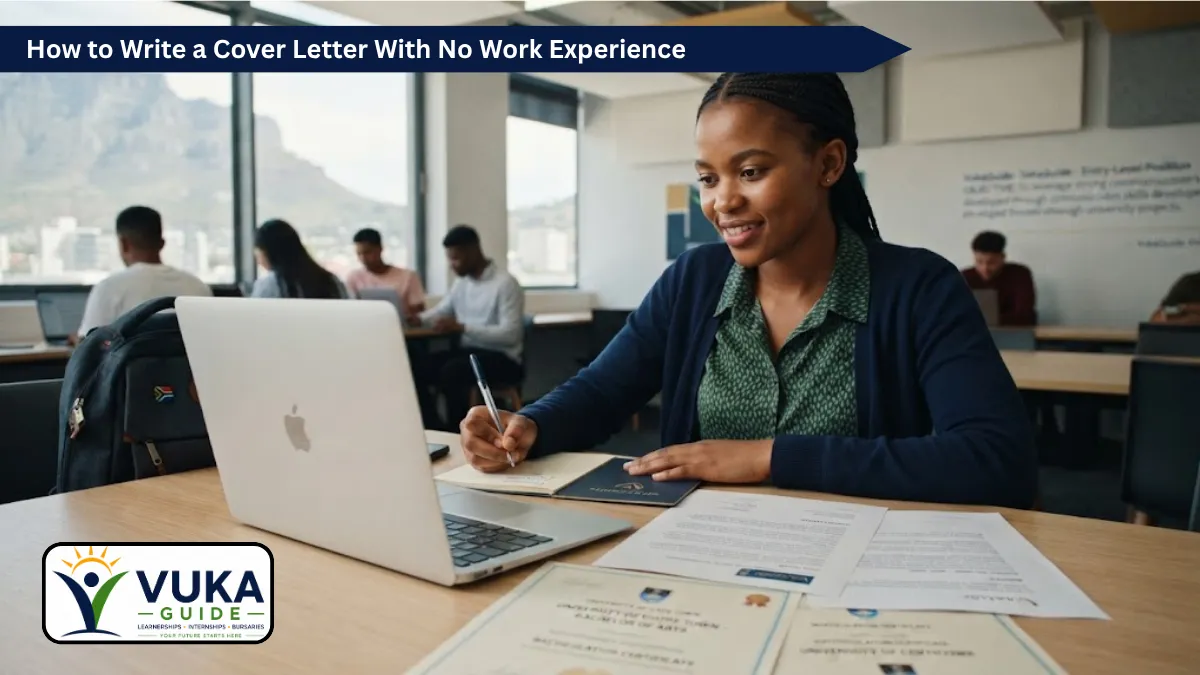
Writing a cover letter can be challenging when you are applying for your first job and do not have previous employment experience.
However, having no work experience does not mean you have nothing to say. A strong cover letter can focus on your education, relevant skills, achievements, volunteer activities, projects, career goals and willingness to learn.
For South African students, school leavers, graduates and unemployed youth, the goal is to show an employer that you understand the opportunity, meet the requirements where applicable and are motivated to contribute.
This VukaGuide guide explains how to write a professional cover letter when you have no formal work experience, what to include and provides an example you can adapt.
What Is a Cover Letter?
A cover letter is a short document submitted with your CV when applying for a job or other opportunity.
It gives you an opportunity to explain:
- Why you are applying
- Why you are interested in the organisation
- What skills you can offer
- How your education relates to the position
- Why you believe you could be a good candidate
Your CV provides the facts about your background, while the cover letter allows you to put those facts into context.
Can You Write a Cover Letter Without Work Experience?
Yes.
Employers know that young people applying for entry-level jobs may not have extensive employment histories.
Instead of focusing on what you do not have, use your cover letter to highlight what you can offer.
This might include:
- Grade 12 or another qualification
- Relevant subjects
- Diploma or degree
- Computer skills
- Communication skills
- Teamwork
- Leadership
- Volunteer experience
- School or university projects
- Community involvement
- Short courses
- Learnership or internship experience
- Willingness to learn
The key is to connect these strengths to the position you are applying for.
What Should a Cover Letter Include?
A simple cover letter can contain:
- Your contact details
- The date
- Employer or organisation details, where available
- A professional greeting
- Opening paragraph
- Education and relevant skills
- Why you are interested in the position
- Closing paragraph
- Your name
A first-job cover letter does not need to be several pages long.
One page is usually enough.
1. Start With Your Contact Details
At the top of the letter, include basic contact information.
For example:
Thabo Mokoena
Polokwane, Limpopo
071 000 0000
thabomokoena@email.com
You do not normally need to include your full residential address unless the employer requests it.
2. Add the Date
Include the date on which you are submitting your application.
For example:
20 August 2026
If you are applying through an online recruitment system, follow any formatting instructions provided by the employer.
3. Address the Employer Professionally
If you know the recruiter’s name, you can use it.
For example:
Dear Ms Mokoena,
If you do not know the person’s name, use a professional alternative such as:
Dear Hiring Manager,
Avoid overly casual greetings.
4. Write a Strong Opening Paragraph
The opening should immediately tell the employer:
- Which position you are applying for
- Where you saw the opportunity, if relevant
- Why you are interested
For example:
I am writing to apply for the Administrative Assistant position advertised on your careers website. As a recent Grade 12 graduate with strong computer, communication and organisational skills, I am eager to begin my career and contribute positively to your organisation.
Notice that the example does not apologise for having no experience.
That is important.
5. Do Not Apologise for Having No Experience
Avoid opening your letter with:
I know I have no experience, but please give me a chance.
This immediately focuses attention on what you lack.
Instead, focus on your strengths.
For example:
Although I am at the beginning of my career, I have developed strong communication, teamwork and organisational skills through my education, community activities and school projects.
This presents your situation positively without making false claims.
6. Explain Your Education
Your education can be particularly important when you have no formal employment history.
Explain how your qualification relates to the position.
For example:
I recently completed my National Senior Certificate and developed strong communication and computer skills through my schoolwork and extracurricular activities. I am particularly interested in this opportunity because it would allow me to apply these skills in a professional environment while gaining practical experience.
If you have a diploma or degree, explain how your studies prepared you for the role.
7. Highlight Transferable Skills
Transferable skills are abilities that can be useful in different workplaces.
Examples include:
- Communication
- Teamwork
- Problem solving
- Time management
- Organisation
- Leadership
- Customer service
- Computer literacy
- Attention to detail
- Research
- Presentation skills
Do not simply list ten skills without evidence.
Where possible, explain where you developed them.
For example:
During my studies, I regularly worked on group assignments, which strengthened my teamwork, communication and time-management skills.
This is more convincing than simply saying:
I am a great team player.
8. Mention School, College or University Projects
Projects can provide evidence of your abilities.
For example, you could mention:
- Research projects
- Group assignments
- Presentations
- Community projects
- Entrepreneurship projects
- Computer projects
- Student organisations
A project can demonstrate that you know how to plan, research, communicate and complete tasks.
9. Include Volunteer Experience
Volunteer experience can be valuable when applying for your first job.
For example:
Through volunteering at a community organisation, I assisted with event preparation, communicated with community members and helped organise materials. This experience strengthened my ability to work with others and complete tasks responsibly.
Only include activities you genuinely participated in.
10. Explain Why You Want the Job
Employers want to know that you have an actual interest in the opportunity.
Avoid generic statements such as:
I need a job because I am unemployed.
Instead, explain what attracts you to the role.
For example:
I am interested in this position because it offers an opportunity to develop my administrative skills while contributing to an organisation that serves the community.
Research the employer before writing this section.
Mention something specific about the organisation or role where appropriate.
11. Show That You Are Willing to Learn
For entry-level positions, employers may value a candidate’s attitude and willingness to develop.
You could write:
I am eager to learn from experienced colleagues, develop my professional skills and take responsibility for the tasks assigned to me.
This is especially useful when applying for:
- Entry-level jobs
- Learnerships
- Internships
- Apprenticeships
- Graduate programmes
12. Connect Your Skills to the Job
Your cover letter becomes stronger when you connect your abilities directly to the vacancy.
For example, if the job requires customer service, you might write:
My communication and interpersonal skills would allow me to interact professionally with customers and colleagues, while my willingness to learn would help me adapt quickly to the organisation’s procedures.
If the job requires computer skills:
I have experience using Microsoft Word and Excel for academic assignments and am confident in learning additional workplace systems.
Only mention software you genuinely know.
13. Keep Your Cover Letter Short
A good first-job cover letter generally does not need to be longer than one page.
Aim for approximately 250–400 words, depending on the requirements of the vacancy.
Recruiters may review many applications, so make your most important information easy to find.
14. Avoid Generic Cover Letters
One of the biggest mistakes is sending exactly the same cover letter to every employer.
Instead, change:
- Job title
- Organisation name
- Relevant skills
- Qualification
- Reason for applying
- Examples of experience
For example, a cover letter for a retail job should emphasise customer service and communication, while a cover letter for an administrative position should focus more on organisation and computer skills.
15. Use Keywords From the Job Advert
Read the vacancy carefully.
If the employer asks for:
- Communication skills
- Computer literacy
- Customer service
- Administration
- Attention to detail
and you genuinely possess those skills, incorporate relevant wording naturally into your cover letter.
This helps demonstrate that you have read the advert and understand what the employer is looking for.
Do not copy entire sentences from the job advertisement.
16. End With a Professional Closing
Your final paragraph should express interest and indicate that you are available for further consideration.
For example:
Thank you for considering my application. I would welcome the opportunity to discuss how my skills, education and willingness to learn could contribute to your organisation. I look forward to hearing from you.
Then close with:
Kind regards,
Thabo Mokoena
Cover Letter Example With No Work Experience
Thabo Mokoena
Polokwane, Limpopo
071 000 0000
thabomokoena@email.com
20 August 2026
Hiring Manager
ABC Company
South Africa
Dear Hiring Manager,
RE: Application for Administrative Assistant Position
I am writing to apply for the Administrative Assistant position advertised by ABC Company. I am a recent Grade 12 graduate who is eager to begin a professional career and gain practical workplace experience. I believe my communication, organisational and computer skills would allow me to contribute positively to your team.
Although I have not yet held a formal full-time position, I have developed useful transferable skills through my education, school projects and community activities. I am comfortable working as part of a team, completing tasks within deadlines and communicating respectfully with different people. I also have basic computer skills and am willing to learn new systems and procedures.
I am particularly interested in this opportunity because it would allow me to develop my administrative abilities while gaining valuable workplace experience. I am a motivated and responsible person who is prepared to learn from experienced colleagues and take responsibility for assigned tasks.
I have attached my CV for your consideration. Thank you for taking the time to review my application. I would appreciate the opportunity to discuss my suitability for the position.
Kind regards,
Thabo Mokoena
Cover Letter Example for a Learnership
When applying for a learnership, you can focus more heavily on your qualification, career interests and willingness to learn.
Dear Hiring Manager,
RE: Application for Learnership Opportunity
I am writing to express my interest in the advertised learnership opportunity. I recently completed my National Senior Certificate and am eager to develop practical workplace skills while working towards a recognised qualification.
My education has helped me develop communication, teamwork, problem-solving and time-management skills. I am particularly interested in this learnership because it combines structured learning with practical workplace exposure, which would provide an important foundation for my career.
Although I am at the beginning of my professional journey, I am hardworking, willing to learn and committed to completing the programme successfully. I would welcome the opportunity to learn from experienced professionals and contribute positively to the organisation.
Thank you for considering my application. I have attached my CV and supporting documents for your consideration.
Kind regards,
[Full Name]
Common Cover Letter Mistakes to Avoid
1. Starting With an Apology
Do not begin by repeatedly saying you have no experience.
2. Making False Claims
Never invent employment, qualifications, skills or achievements.
3. Using the Same Letter Everywhere
Tailor your cover letter to each position.
4. Making It Too Long
Keep your letter focused and relevant.
5. Using Informal Language
A cover letter is a professional document.
6. Repeating Your Entire CV
Use the cover letter to explain your suitability rather than copying every section of your CV.
7. Forgetting the Job Title
Clearly state the position you are applying for.
8. Not Checking for Errors
Spelling and grammar mistakes can make your application appear careless.
Should You Send a Cover Letter If It Is Not Required?
If an employer specifically asks for a cover letter, you should provide one.
If it is optional, submitting a short, well-written cover letter can help explain your interest, particularly when you are applying for your first job and your CV contains limited employment history.
However, always follow the employer’s application instructions.
If the application system specifically says “CV only”, do not ignore those instructions by uploading additional documents.
How to Send Your Cover Letter
Unless the employer specifies another format, save your cover letter as a PDF.
Use a professional file name, such as:
Thabo_Mokoena_Cover_Letter.pdf
If you are applying by email, keep the email itself short and professional and attach the documents requested by the employer.
First Job Cover Letter Checklist
- Include your name and contact details
- Add the date
- Address the employer professionally
- Clearly state the position you are applying for
- Explain why you are interested
- Mention your relevant education
- Highlight genuine transferable skills
- Include relevant projects or volunteer experience
- Explain your willingness to learn
- Tailor the letter to the vacancy
- Keep it to about one page
- Check spelling and grammar
- Save it in the requested format
- Use a professional file name
VukaGuide Expert Guidance
Your lack of formal employment experience should not prevent you from writing a convincing cover letter.
The strongest approach is to replace employment history with evidence of potential. Your education, projects, volunteering, leadership activities and skills can all help demonstrate that you are prepared to enter the workplace.
Most importantly, remain honest. Do not create a fictional work history simply because a vacancy asks for experience.
A good first-job application tells the employer three things clearly: what you have learned, what you can contribute and why you want the opportunity.
As you gain internships, learnerships, part-time work or permanent employment, continue updating both your CV and cover letter approach.
Frequently Asked Questions
Can I write a cover letter if I have never worked before?
Yes. Focus on your education, transferable skills, projects, achievements, volunteering and willingness to learn.
How long should my cover letter be?
For most first-job applications, approximately 250–400 words and one page is sufficient.
Should I mention that I have no experience?
You do not need to make your lack of experience the focus of the letter. Instead, explain the relevant skills and experience you have gained through education and other activities.
Can a school leaver write a cover letter?
Yes. School leavers can use education, school projects, leadership activities, community involvement and transferable skills to demonstrate their potential.
Do I need a cover letter for every job?
Not necessarily. Follow the employer’s application instructions. If a cover letter is requested, submit one. If it is optional, decide whether it adds useful information to your application.
Should my cover letter repeat my CV?
No. Your cover letter should complement your CV by explaining your motivation and connecting your background to the position.
Disclaimer
VukaGuide provides general career guidance for South African job seekers. Cover letter requirements can vary between employers, so applicants should always follow the specific instructions in the relevant vacancy advertisement.
Trust Signals
Written by: VukaGuide Editorial Team
Reviewed by: VukaGuide Editorial Team
Published: 20 August 2026
Last Updated: 20 August 2026
Reading Time: 6–8 min read
Editorial Review:
This guide has been reviewed for practical relevance to South African students, graduates and first-time job seekers preparing applications without formal employment experience.
Discover Relevant VukaGuide Content Such As:
- How to Create a CV for Your First Job in South Africa
- Latest Learnerships
- Latest Internships
- Graduate Programmes
- How to Prepare for a Job Interview
- Z83 Application Form Guide
- Government Jobs
- Career Advice

About
Mokoena
Puseletso Mokoena is a Vukaguide contributor who writes practical and informative content for South African job seekers, students, graduates and young professionals.
Puseletso covers employment opportunities, learnerships, internships, bursaries, education, skills development and career guidance. The focus is on making opportunity information easier to understand and helping readers navigate application requirements and processes.
Vukaguide articles by Puseletso Mokoena are written with a focus on clear, useful and factual information, with opportunity details checked against available source information where possible.