
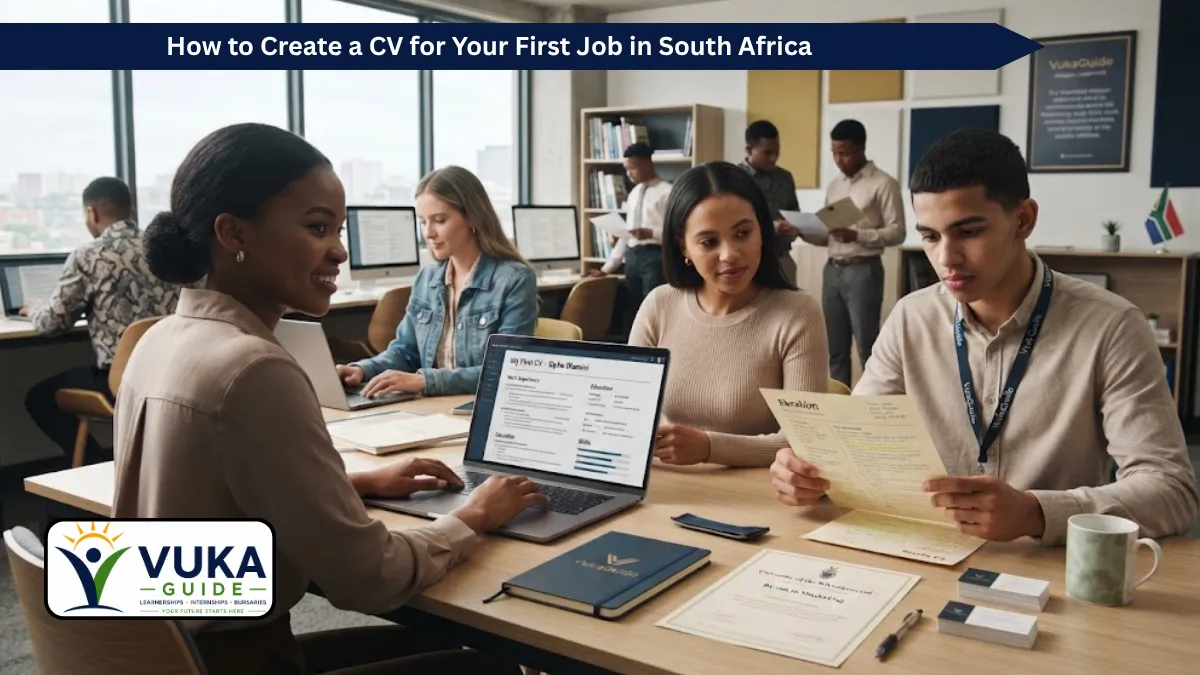
Getting your first job in South Africa can feel difficult when most vacancies ask for experience. The good news is that you do not need years of employment history to create a strong CV.
If you are a school leaver, graduate, student or young job seeker applying for your first job, your CV should focus on your education, skills, achievements, practical experience and willingness to learn.
A well-structured CV can help employers quickly understand who you are, what you can offer and whether you meet the requirements of the position.
This VukaGuide explains how to create a professional CV for your first job in South Africa, including what to include, what to leave out and how to tailor your CV for different vacancies.
What Is a CV?
A CV, or curriculum vitae, is a document that summarises your education, skills, experience, achievements and other information relevant to employment.
For a first-time job seeker, the CV does not have to be filled with previous jobs.
Instead, it should demonstrate your potential by showing relevant education, transferable skills, school or university achievements, volunteer activities, projects and other practical experience.
How Long Should a First CV Be?
For most first-time job seekers, one to two pages is enough.
Do not make your CV longer simply to make it look more impressive.
Employers should be able to identify your:
- Contact details
- Career objective or profile
- Education
- Skills
- Experience
- Achievements
- References
quickly.
1. Add Your Contact Details
Start your CV with your basic contact information.
Include:
- Full name
- Mobile phone number
- Professional email address
- City and province
- LinkedIn profile, if you have one
For example:
Thabo Mokoena
Polokwane, Limpopo
071 000 0000
thabomokoena@email.com
Your email address should look professional.
An address based on your name is usually better than an email containing nicknames, jokes or unnecessary numbers.
Do You Need to Include Your Full Home Address?
Usually, no.
For most applications, your city and province are sufficient unless the employer specifically asks for your full residential address.
2. Write a Short Personal Profile
A personal profile is a short introduction explaining who you are and what type of opportunity you are looking for.
Keep it relevant to the job.
For example:
Motivated South African school leaver with a Grade 12 qualification and strong communication, teamwork and computer skills. Seeking an entry-level opportunity to gain practical workplace experience while contributing positively to a professional team.
Avoid writing a long personal story.
The profile should take only a few lines.
3. Include Your Education
Education is particularly important when you do not have employment experience.
List your most recent qualification first.
Include:
- Qualification
- School, college or university
- Year completed
- Relevant subjects or modules where useful
For example:
National Senior Certificate (Grade 12)
Makhado Secondary School
Completed: 2025
If you are a university or college graduate, include your qualification and institution.
For example:
Diploma in Business Management
TVET College
Completed: 2026
You generally do not need to list every subject unless the vacancy specifically requires certain subjects.
4. Highlight Relevant Skills
Skills can make a major difference when applying for your first job.
Think about skills you developed through school, university, community activities, projects, volunteering or everyday responsibilities.
Examples include:
- Communication
- Teamwork
- Customer service
- Computer literacy
- Microsoft Word
- Microsoft Excel
- Time management
- Problem solving
- Organisation
- Attention to detail
- Research
- Presentation skills
- Social media management
Do not simply copy a list of skills from the job advert.
Choose skills you genuinely have and, where possible, demonstrate them through examples.
5. You Can Include Experience Even Without a Previous Job
Having no formal employment history does not necessarily mean you have no experience.
You may have gained useful experience through:
- Volunteering
- School leadership
- Community projects
- Student organisations
- Work-integrated learning
- Internships
- Learnerships
- Freelance projects
- Family business activities
- University assignments
- Part-time work
For example, if you helped organise a school event, you may have developed planning, communication and teamwork skills.
If you assisted a community organisation with administration, you can describe the responsibilities you performed.
The important thing is to present genuine experience honestly.
6. Create an Experience Section
If you have any relevant practical experience, create an Experience section.
Example:
Volunteer Administrative Assistant
Community Organisation | 2025
- Assisted with basic administrative tasks.
- Helped organise documents and records.
- Communicated with community members.
- Assisted with event preparation.
- Used Microsoft Word to prepare documents.
This is much more useful than simply writing:
No work experience.
7. Include Achievements
Achievements can help demonstrate your abilities.
You could include:
- Academic awards
- Leadership positions
- Sports achievements
- Debate competitions
- School projects
- University projects
- Community involvement
- Certificates
- Competitions
- Volunteer recognition
Only include genuine achievements.
8. Add Relevant Certifications
If you have completed additional training, create a Certifications section.
Examples could include:
- First Aid
- Computer courses
- Microsoft Office training
- Occupational certificates
- Industry-specific training
- Short courses
- Online courses
Make sure the qualification or certificate is relevant or adds value to the application.
9. Tailor Your CV for Every Job
One of the biggest mistakes first-time job seekers make is sending exactly the same CV to every employer.
Instead, adjust your CV according to the vacancy.
For example, if you are applying for an administrative position, emphasise:
- Computer literacy
- Microsoft Office
- Organisation
- Filing
- Communication
- Data capturing
For a retail position, emphasise:
- Customer service
- Communication
- Teamwork
- Reliability
- Product knowledge
For a learnership, highlight:
- Education
- Relevant subjects
- Skills
- Certificates
- Willingness to learn
10. Use Keywords From the Job Advert
Read the vacancy carefully and identify important requirements.
If the advert repeatedly mentions terms such as computer literacy, customer service, communication and administration, and you genuinely possess those skills, make sure they are clearly reflected in your CV.
This can also help your CV perform better when employers use applicant-tracking systems to screen applications.
However, never claim that you have a qualification or skill that you do not actually possess.
11. Keep the Design Professional
Your CV does not need complicated graphics or bright colours.
Use:
- Clear headings
- Consistent fonts
- Easy-to-read spacing
- Short bullet points
- Logical sections
- Consistent formatting
A simple professional design is usually better than a heavily decorated CV.
12. Do You Need a Photo on Your CV?
A photograph is generally not necessary unless the employer specifically requests one.
For most South African job applications, your qualifications, skills and experience are more important than including a photograph.
13. References
If the employer requests references, provide people who can genuinely speak about your character, education or experience.
Depending on your background, this could include:
- Teacher
- Lecturer
- Volunteer coordinator
- Previous supervisor
- Internship supervisor
- Community organisation leader
Always ask the person for permission before listing them as a reference.
Include:
- Full name
- Position
- Organisation
- Contact number
- Email address
Do not invent references.
14. What You Should Not Put on Your CV
Avoid unnecessary or potentially distracting information.
Do not include:
- False qualifications
- Fake employment history
- Unnecessary personal information
- Passwords
- Banking details
- ID numbers unless specifically requested
- Long paragraphs about your personal life
- Unprofessional email addresses
- Information unrelated to the vacancy
Never lie on a CV.
Employers may verify qualifications, employment history and other information during recruitment.
15. Check Your CV Before Sending It
Before submitting your application, check for spelling and formatting mistakes.
Make sure:
- Your phone number is correct.
- Your email address works.
- Dates are accurate.
- Qualification names are correct.
- Your CV is easy to read.
- There are no unnecessary blank pages.
- Your file opens correctly.
- Your name is clearly displayed.
- Your information matches the application form.
If possible, ask someone you trust to proofread it.
16. Save Your CV as a PDF
Unless the employer requests another format, saving your CV as a PDF can help preserve the formatting.
Use a professional file name.
Instead of:
CV final final 2.pdf
use:
Thabo_Mokoena_CV.pdf
If the vacancy gives specific instructions about file formats or naming conventions, follow those instructions instead.
First Job CV Structure
A simple first-job CV can follow this structure:
1. Personal Details
Name, phone number, email and location.
2. Personal Profile
Two to four lines explaining your background and career objective.
3. Education
Your highest or most relevant qualifications.
4. Skills
Relevant technical and transferable skills.
5. Experience
Employment, volunteering, internships, projects or other relevant practical experience.
6. Achievements
Awards, leadership, projects and other relevant accomplishments.
7. Certifications
Relevant additional training.
8. References
Only if required or useful.
First Job CV Example
THABO MOKOENA
Polokwane, Limpopo
071 000 0000
thabomokoena@email.com
Personal Profile
Motivated Grade 12 school leaver seeking an entry-level opportunity to gain practical workplace experience. Strong communication, teamwork and computer skills, with a positive attitude and willingness to learn.
Education
National Senior Certificate
Makhado Secondary School
Completed: 2025
Skills
- Communication
- Teamwork
- Computer literacy
- Microsoft Word
- Time management
- Problem solving
- Customer service
- Attention to detail
Volunteer Experience
Community Volunteer
Local Community Organisation | 2025
- Assisted with community activities and events.
- Helped organise documents and materials.
- Communicated with members of the community.
- Worked with other volunteers to complete assigned tasks.
Achievements
- Participated in school leadership activities.
- Completed computer literacy training.
- Participated in community volunteer activities.
References
Available on request.
Final CV Checklist
Before sending your first-job application, make sure your CV:
- Has your correct phone number and email address
- Contains a short professional profile
- Clearly lists your education
- Includes relevant skills
- Shows genuine practical experience where available
- Includes relevant achievements or certifications
- Is tailored to the vacancy
- Has no spelling or grammatical errors
- Does not contain false information
- Is saved in the requested format
- Has a professional file name
VukaGuide Expert Guidance
Your first CV does not need to prove that you have already built a long career. Its purpose is to show an employer what you have learned, what you can do and why you could be a good fit for the opportunity.
If you have no formal work experience, focus on transferable skills and genuine activities that demonstrate responsibility, communication, teamwork and willingness to learn.
Most importantly, do not create experience that you do not have. A simple, honest and well-organised CV is far more valuable than an impressive-looking CV containing information that cannot be verified.
As you gain experience through internships, learnerships, volunteering, part-time work and your first permanent position, continue updating your CV so that it becomes a record of your professional development.
Frequently Asked Questions
Can I get a job with no work experience?
Yes. Some entry-level jobs, learnerships, internships and other opportunities are specifically designed for people who are starting their careers. Your CV should highlight your education, skills and genuine practical experience.
How many pages should my first CV be?
For most first-time job seekers, one to two pages is sufficient.
Should I include my Grade 11 results?
If you have already completed Grade 12, your Grade 12 qualification is generally more relevant. However, include specific school subjects or results if the employer requires them.
Should I put my ID number on my CV?
Usually, no, unless the employer specifically requests it.
Should I include a photo?
A photo is generally unnecessary unless the employer specifically asks applicants to provide one.
Can I use the same CV for every job?
It is better to tailor your CV to each vacancy so that your most relevant education, skills and experience are easy for the employer to identify.
Disclaimer
VukaGuide provides career information to help South African job seekers prepare for employment opportunities. Requirements can differ between employers, so applicants should always follow the specific instructions provided in the vacancy advertisement.
Trust Signals
Written by: VukaGuide Editorial Team
Reviewed by: VukaGuide Editorial Team
Published: 19 August 2026
Last Updated: 19 August 2026
Reading Time: 6–8 min read
Editorial Review:
This guide has been reviewed for practical relevance to South African first-time job seekers and is intended as general career guidance.
Discover Relevant VukaGuide Content Such As:
- Learnerships
- Internships
- Graduate Programmes
- Government Jobs
- How to Apply for Jobs Online
- How to Prepare for a Job Interview
- Z83 Application Form Guide

About
Mokoena
Puseletso Mokoena is a Vukaguide contributor who writes practical and informative content for South African job seekers, students, graduates and young professionals.
Puseletso covers employment opportunities, learnerships, internships, bursaries, education, skills development and career guidance. The focus is on making opportunity information easier to understand and helping readers navigate application requirements and processes.
Vukaguide articles by Puseletso Mokoena are written with a focus on clear, useful and factual information, with opportunity details checked against available source information where possible.
3 thoughts on “How to Create a CV for Your First Job in South Africa”