
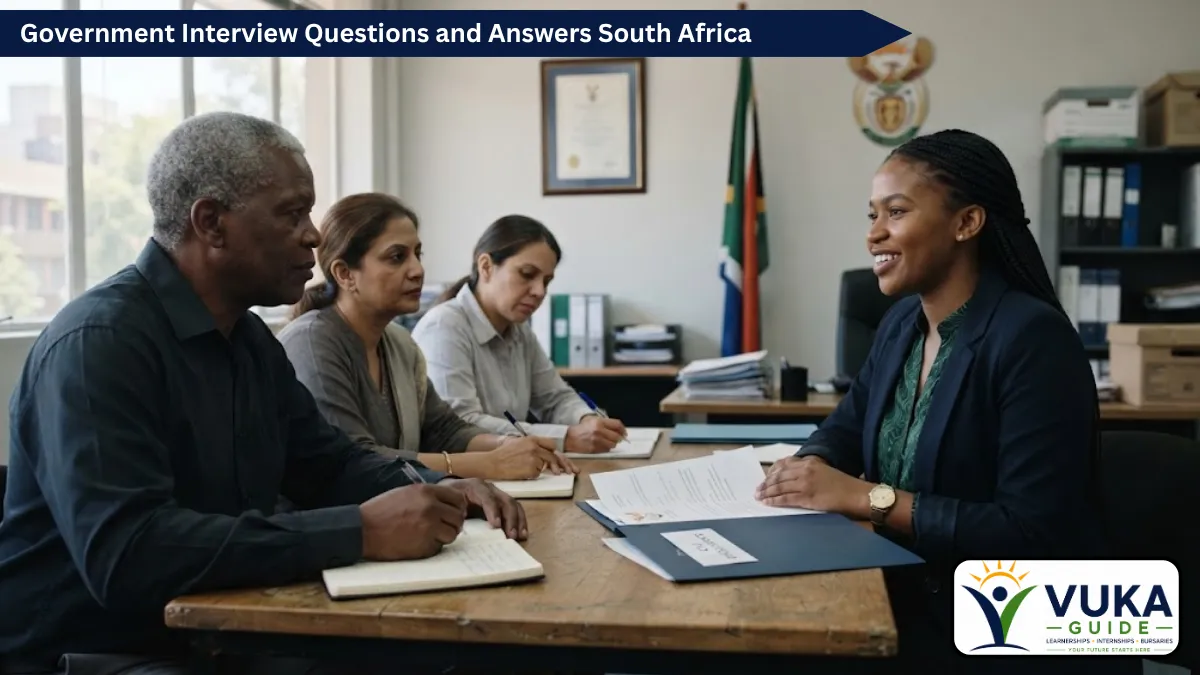
Getting invited to a government job interview is an important step in the recruitment process, but the interview itself can determine whether your application progresses further.
South African government interviews may assess your qualifications, technical knowledge, communication skills, problem-solving ability, teamwork, professionalism and understanding of the position.
For graduates, interns and first-time job seekers, the biggest challenge can be knowing what questions to expect.
While there is no guaranteed list of questions that every government department will ask, preparing for common interview themes can help you organise your thoughts and communicate your experience more effectively.
This VukaGuide guide provides 20 common government interview questions with sample answer approaches to help South African job seekers prepare.
Quick Overview
| Information | Details |
|---|---|
| Guide Topic | Government Interview Questions and Answers |
| Country | South Africa |
| Suitable For | Government job seekers, graduates, interns and learnership applicants |
| Interview Format | In-person, virtual or panel interview |
| Main Preparation | Vacancy, organisation, competencies and examples |
| Answer Method | STAR method for experience-based questions |
1. Tell Us About Yourself
This is one of the most common opening questions.
How to Answer
Keep your response professional and relevant to the position.
Mention:
- Your qualification
- Relevant experience
- Important skills
- Your interest in the position
Sample Answer
“I recently completed my qualification in Public Management and developed strong administrative, communication and computer skills through my academic projects and practical experience. I am organised, willing to learn and interested in developing my career in public service. I applied for this position because it matches my qualification and gives me an opportunity to contribute while gaining further practical experience.”
Avoid telling the panel your entire personal history.
2. Why Do You Want to Work for This Department?
How to Answer
Research the department before the interview.
Explain what interests you about its mandate and connect that with your skills and career goals.
Sample Answer
“I am interested in working for this department because its work directly contributes to public services. My qualification has given me knowledge that is relevant to this position, and I would like to apply that knowledge in a practical environment while continuing to develop professionally.”
Avoid saying that you only want the position because you need a salary.
3. Why Should We Appoint You?
How to Answer
Focus on what you can contribute rather than simply saying you are hardworking.
Mention two or three strengths relevant to the vacancy.
Sample Answer
“I believe I would be a suitable candidate because I meet the educational requirements and have strong communication, organisational and computer skills. I am also willing to learn, follow procedures and work effectively with colleagues. I would bring a professional attitude and a commitment to completing my responsibilities accurately.”
4. What Do You Know About Our Department?
How to Answer
This question tests whether you prepared for the interview.
Before the interview, research:
- The department’s mandate
- Main services
- Current programmes
- The division where the position is located
- The responsibilities of the advertised post
Sample Answer
“I understand that the department is responsible for [briefly explain its mandate]. I also researched the unit associated with this position and understand that the role supports [relevant function]. That is one of the reasons I was interested in applying.”
Do not guess if you are unsure about a specific fact.
5. What Are Your Strengths?
How to Answer
Choose strengths that are relevant to the position.
Good examples include:
- Communication
- Organisation
- Teamwork
- Problem-solving
- Attention to detail
- Time management
- Computer literacy
Sample Answer
“One of my strengths is organisation. I like planning my work, keeping track of deadlines and checking my work before submitting it. This helped me manage multiple assignments and group responsibilities during my studies.”
The example makes the strength more credible.
6. What Is Your Weakness?
How to Answer
Choose a genuine but manageable development area and explain what you are doing to improve it.
Sample Answer
“Earlier in my studies, I sometimes spent too much time trying to perfect a task before moving on to the next one. I have been improving by setting realistic deadlines, prioritising tasks and checking my work efficiently.”
Avoid saying:
“I have no weaknesses.”
It can make the answer sound unprepared.
7. Tell Us About a Time You Worked in a Team
This is a good opportunity to use the STAR method.
S — Situation
T — Task
A — Action
R — Result
Sample Answer
“During a university project, I worked with several classmates to complete a research assignment. We divided the work according to each person’s strengths and agreed on deadlines. I was responsible for researching my section and helping combine the final information. We completed the project on time and presented our findings successfully.”
Use a real example from your own experience.
8. Tell Us About a Time You Solved a Problem
How to Answer
Explain the situation, what you did and the result.
Sample Answer
“During a group assignment, we discovered that some of our information was incomplete shortly before the deadline. I helped the team identify what was missing, divided the remaining research between members and helped organise the information into the final report. We completed the assignment before the deadline.”
Do not invent achievements.
9. How Do You Handle Pressure?
Sample Answer
“I handle pressure by identifying which tasks are most urgent, breaking larger tasks into smaller steps and keeping track of deadlines. If I need assistance or clarification, I communicate early rather than waiting until the deadline is close.”
Where possible, add a real example.
10. How Would You Deal With an Angry Member of the Public?
This is particularly relevant to positions involving public interaction.
Sample Answer
“I would remain calm and professional, listen carefully to the person’s concern and make sure I understand the issue. I would explain what I can do within the relevant procedures and, if necessary, refer the matter to the appropriate person or supervisor. I would avoid arguing with the individual and would treat them respectfully throughout the interaction.”
11. How Do You Handle Conflict With a Colleague?
Sample Answer
“I would first try to understand the other person’s perspective and discuss the issue professionally. I would focus on the work-related problem rather than making the disagreement personal. If we could not resolve the issue ourselves, I would follow the appropriate workplace procedure and seek guidance from a supervisor.”
12. What Would You Do If You Made a Mistake?
Sample Answer
“I would take responsibility for the mistake, assess its impact and inform the appropriate person if necessary. I would then correct the error as soon as possible and identify what caused it so that I could avoid repeating it.”
Avoid suggesting that you would hide the mistake.
13. How Do You Prioritise Your Work?
Sample Answer
“I start by reviewing all the tasks I have been given and identifying deadlines and priorities. I deal with urgent and important tasks first, then schedule the remaining work. I also keep track of progress so that I can communicate early if a deadline may be affected.”
14. How Would You Handle Confidential Information?
Government employees may work with sensitive information.
Sample Answer
“I would treat confidential information responsibly and only access or share it where I am authorised to do so. I would follow the department’s policies and procedures for storing, handling and sharing information and would ask my supervisor for guidance if I was unsure.”
Never suggest sharing confidential information with friends or unauthorised people.
15. What Would You Do If Someone Asked You to Break a Procedure?
Sample Answer
“I would not ignore the required procedure simply because someone asked me to. I would explain that I need to follow the applicable rules and, if necessary, raise the matter with my supervisor or the appropriate official.”
The exact response should depend on the circumstances and applicable workplace procedures.
16. What Does Good Customer Service Mean to You?
Sample Answer
“Good customer service means treating people respectfully, listening to their concerns, communicating clearly and providing accurate information. It also means understanding the limits of my role and referring matters appropriately when I cannot resolve them myself.”
17. Where Do You See Yourself in Five Years?
How to Answer
Show ambition while keeping your answer realistic.
Sample Answer
“Over the next five years, I would like to develop strong practical experience in my field, take on increasing responsibility and continue improving my professional skills. I would like to build a career where I can make a meaningful contribution to the organisation.”
You do not need to claim that you will definitely hold a specific senior position.
18. Why Should We Choose You Over Other Candidates?
This question can be difficult.
Do not criticise other candidates because you do not know their abilities.
Sample Answer
“I cannot comment on the other candidates, but I can explain what I would bring to the position. I meet the relevant requirements, have skills that match the role and am willing to learn. I would approach the position professionally and take responsibility for producing accurate, reliable work.”
19. What Salary Do You Expect?
For government vacancies, the advertisement may already provide information about the salary or salary level.
How to Answer
If the vacancy specifies a salary, show that you understand the advertised conditions.
Sample Answer
“I understand that the position has an advertised salary or salary level. I am comfortable discussing the remuneration within the conditions specified for the position.”
For internships and learnerships, refer to the advertised stipend rather than assuming that the opportunity offers a permanent employee salary.
20. Do You Have Any Questions for Us?
Always be prepared for this question.
You could ask:
- “What would be the main priorities for the successful candidate?”
- “What skills are most important for succeeding in this role?”
- “What does the team structure look like?”
- “What are the next steps in the recruitment process?”
Avoid asking something that was already clearly explained during the interview.
How to Use the STAR Method
The STAR method is particularly useful for questions that begin with:
- Tell us about a time…
- Give us an example…
- Describe a situation…
- How did you handle…?
Situation
Briefly explain the circumstances.
Task
Explain what you needed to accomplish.
Action
Focus on what you did.
Result
Explain what happened because of your actions.
A strong STAR answer should not spend most of its time describing the background.
The panel wants to understand your contribution.
What If You Have No Work Experience?
Do not panic.
If you are a graduate or first-time job seeker, you can use genuine examples from:
- University projects
- College assignments
- Volunteering
- Student organisations
- Community projects
- Internships
- Learnerships
- Part-time employment
- Leadership activities
For example, a question about teamwork can be answered using a university group project.
The key is to explain the situation honestly and show what you learned.
Government Interview Mistakes to Avoid
Avoid:
- Arriving late
- Not researching the department
- Giving memorised answers that sound unnatural
- Speaking negatively about previous employers
- Inventing experience
- Claiming skills you do not possess
- Interrupting panel members
- Giving extremely long answers
- Refusing to acknowledge mistakes
- Ignoring questions
- Using your phone during the interview
- Failing to follow interview instructions
Government Interview Preparation Checklist
Before the interview, make sure you have:
- Read the complete vacancy advertisement
- Researched the department
- Researched the position
- Reviewed your CV
- Prepared your introduction
- Prepared examples using the STAR method
- Practised common questions
- Checked the interview location or online link
- Prepared requested documents
- Planned your transport
- Selected professional clothing
- Prepared questions for the panel
- Checked your phone and email for updates
Expert Guidance — VukaGuide Editorial Team
Do not try to memorise 20 perfect answers.
Instead, prepare several genuine examples that demonstrate different skills.
One university project could potentially demonstrate teamwork, communication, planning and problem-solving. One volunteer experience could demonstrate customer service or leadership.
The strongest answers are usually specific. Instead of saying “I am hardworking,” explain a situation where you had several responsibilities, how you managed them and what the outcome was.
For government interviews, also take time to understand the department’s mandate and the responsibilities of the position. This allows you to connect your answers to the actual role instead of giving generic responses.
Finally, never invent qualifications, employment history or achievements. Your answers should accurately reflect your experience.
Frequently Asked Questions
What are the most common government interview questions?
Common questions include “Tell us about yourself,” “Why do you want this position?”, “What are your strengths?”, “How do you handle pressure?” and competency-based questions about teamwork, conflict and problem-solving.
How should I answer government interview questions?
Keep your answers relevant, concise and honest. Use specific examples where possible, especially for competency-based questions.
What is the STAR method?
STAR stands for Situation, Task, Action and Result. It provides a structured way to answer questions about previous experiences.
Can I use university examples in an interview?
Yes. If you have limited work experience, genuine examples from academic projects, volunteering, internships and other activities can demonstrate relevant skills.
What should I say if I do not know the answer?
Do not invent an answer. Acknowledge that you are unsure and explain how you would find the correct information or approach the situation professionally.
How long should an interview answer be?
There is no fixed time limit. Give enough information to answer the question properly without going off-topic. Experience-based answers can usually be structured using STAR.
What should I ask at the end of a government interview?
Ask relevant questions about the position, team, expectations or next steps in the recruitment process.
Disclaimer
VukaGuide provides general interview preparation guidance for South African job seekers. Interview questions and recruitment procedures differ between government departments, municipalities and public entities.
Always follow the instructions provided by the recruiting organisation and the specific vacancy advertisement.
VukaGuide is not involved in government recruitment or candidate selection and does not guarantee employment.
Trust Signals
Written by: VukaGuide Editorial Team
Reviewed by: VukaGuide Editorial Team
Published: 19 August 2026
Last Updated: 19 August 2026
Reading Time: 7–9 minutes
Sources:
- South African Government information
- Official government department recruitment information
- Government vacancy advertisements
- Public-sector recruitment guidance
Editorial Review
This article has been reviewed by the VukaGuide Editorial Team for practical relevance and clarity. Interview procedures and requirements can differ between employers, so applicants should always follow the instructions contained in their official interview invitation.
Internal Suggestions
- Government Jobs
- Government Learnerships
- Government Internships
- Government Interview Tips
- How to Write a Government CV
- Latest South African Jobs
- Graduate Programmes
- CV Writing Guide
- Career Advice

About
Mokoena
Puseletso Mokoena is a Vukaguide contributor who writes practical and informative content for South African job seekers, students, graduates and young professionals.
Puseletso covers employment opportunities, learnerships, internships, bursaries, education, skills development and career guidance. The focus is on making opportunity information easier to understand and helping readers navigate application requirements and processes.
Vukaguide articles by Puseletso Mokoena are written with a focus on clear, useful and factual information, with opportunity details checked against available source information where possible.
1 thought on “Government Interview Questions and Answers South Africa: 20 Questions to Prepare For”