
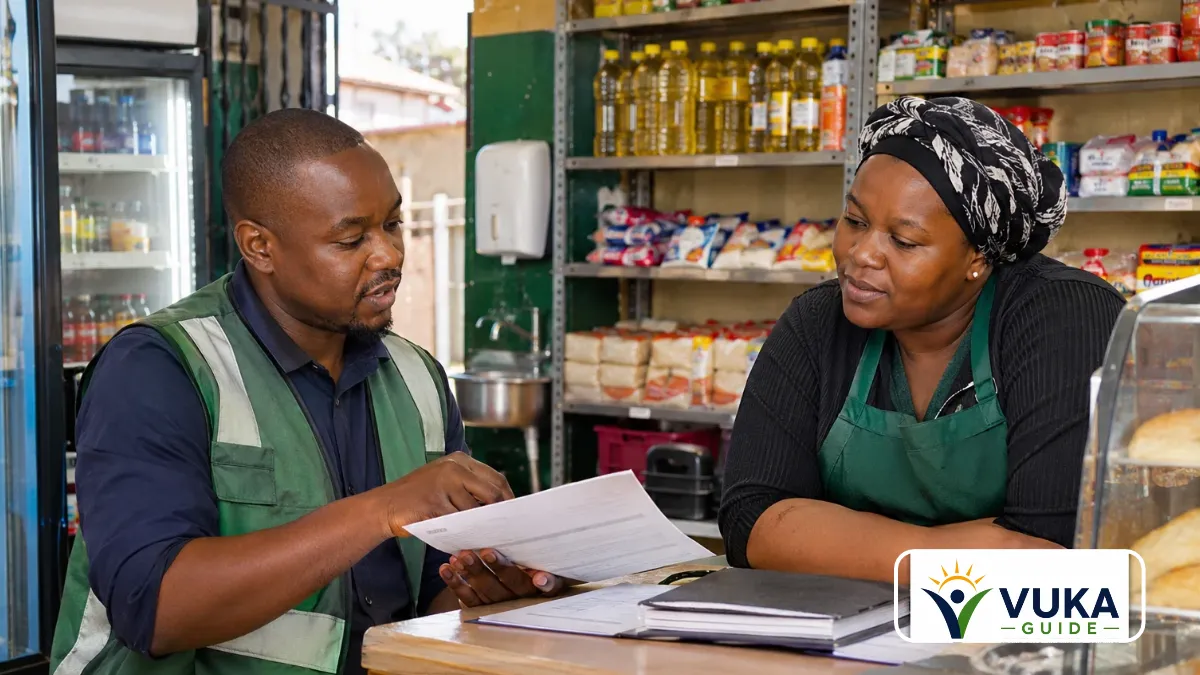
Starting a spaza shop or street food business can be an accessible way to explore entrepreneurship in South Africa. These businesses provide everyday products and food services to communities while creating opportunities for small business owners.
However, operating a business from a home, roadside stall, market space or informal trading area does not mean that you can ignore municipal and food safety requirements.
Depending on the type of business and where it operates, you may need municipal trading permission, a business licence, a Certificate of Acceptability (CoA), suitable land-use permission and compliance with food hygiene regulations.
It is also important to understand that registering a company with the Companies and Intellectual Property Commission (CIPC) is not compulsory for every informal business. A sole proprietor may operate without registering a company, although tax responsibilities still apply.
This guide explains the main steps involved in formalising a street food or spaza business, the documents you may need and the government offices to approach.
Important: Requirements differ between municipalities and business activities. This article provides general guidance, not a substitute for written confirmation from your local municipality or Environmental Health office.
1. Understand the difference between a spaza shop and a street food business
Before starting the registration process, identify the type of business you want to operate.
This matters because a shop operating from a permanent premises may have different requirements from a person selling food from a permitted public trading space.
What is a spaza shop?
A spaza shop is generally a small retail business serving a local community. It may operate from a residential property or another approved premises.
Common products include:
- Packaged groceries
- Bread and other everyday food products
- Household cleaning products
- Toiletries
- Non-alcoholic beverages
- Basic household supplies
Some spaza shops also prepare or sell ready-to-eat food. Those activities introduce additional food handling and safety requirements.
What is a street food business?
A street food business sells prepared food or refreshments to customers, often from a stall, food trailer, designated trading bay or other approved location.
Examples include:
- Cooked meals
- Grilled food
- Sandwiches
- Vetkoek and other prepared snacks
- Non-alcoholic refreshments
- Other ready-to-eat food products
A street food business may require permission to use the trading location, as well as food safety approval.
Why the distinction matters: A business operating from a private property, a municipal trading bay or a food vehicle may face different planning, licensing and inspection requirements.
2. Find out which municipal permissions you need
Your first step should be contacting the municipality where you intend to operate.
Municipalities are responsible for important local matters such as business licensing, informal trading permissions, land-use controls and environmental health services.
Ask the municipality which approvals apply to your proposed business.
Depending on the location and activities, these may include:
- A business or trade licence
- An informal trading permit
- Permission to occupy a designated trading bay
- Zoning or land-use approval
- Building or premises approval
- Fire safety clearance, where applicable
- Environmental health approval
Do not assume that a permit issued in one municipality automatically allows you to operate in another.
Where should you apply?
Contact the following municipal departments or offices:
- Business licensing or trading services
- Informal trading office, if you intend to trade in a public space
- Environmental Health Services
- Town planning or land-use management
- Building control, where applicable
Explain exactly what you intend to sell, where the business will operate and whether food will be prepared on the premises.
The municipality can then advise which application forms and supporting documents are required.
3. Apply for a business or trading licence where required
Some food businesses must obtain a business licence under the Businesses Act and applicable municipal requirements.
The Western Cape Government identifies businesses making or selling food that can go off as among those that generally require a business licence.
Municipalities may assess applications against requirements relating to:
- Public health
- Food safety
- Fire safety
- Land use and zoning
- Premises suitability
- Other applicable municipal by-laws
The precise process and documents depend on the municipality.
For example, the City of Tshwane’s business or trade licence process involves reviews by municipal departments, including health services, fire services, urban planning and building control.
This illustrates why entrepreneurs should not assume that completing one online registration form is enough to obtain permission to operate.
Official information: Western Cape Government – Business Licences
What if you want to sell food in a public space?
If you plan to operate from a pavement, roadside trading area, market or municipal trading bay, you may need an informal trading permit.
The City of Cape Town, for example, requires informal traders using public trading spaces to apply for the relevant permit.
Its process includes registration for municipal e-services, applying for an available trading bay and completing the required assessment.
Food traders must also comply with the relevant food business requirements.
Official information: City of Cape Town – Informal Trading Permit
4. Obtain a Certificate of Acceptability for food premises
One of the most important requirements for businesses that handle food is the Certificate of Acceptability (CoA).
The certificate is issued by the relevant local authority following an assessment of the food premises.
South Africa’s Regulation R638 of 2018 governs general hygiene requirements for food premises, the transport of food and related matters.
It establishes hygiene requirements for food handling, storage, preparation, equipment and premises.
A person operating a food premises must comply with the applicable requirements.
Who needs a Certificate of Acceptability?
You should contact Environmental Health Services if your business will:
- Prepare food for sale
- Cook meals for customers
- Store food intended for public consumption
- Package or process food
- Distribute or transport food
- Sell food products from a premises or trading setup
The exact application requirements depend on the nature of the premises and the municipality.
Do not assume that selling packaged products automatically removes the need for food premises approval. Ask the Environmental Health Practitioner to assess your particular activity.
How to apply for a Certificate of Acceptability
The general process involves:
- Contacting your municipal Environmental Health office.
- Requesting the food premises application form.
- Providing details about the premises and the food activities.
- Submitting the required supporting documents.
- Preparing the premises for an inspection.
- Allowing an Environmental Health Practitioner to assess compliance.
- Addressing any problems identified during the assessment.
- Receiving the certificate if the application is approved.
The certificate must be obtained through the relevant local authority.
What will the health inspection examine?
Depending on the premises and activities, an Environmental Health Practitioner may assess:
- Cleanliness of the premises
- Availability of suitable handwashing facilities
- Access to safe water
- Food preparation and storage arrangements
- Waste disposal
- Pest control
- Suitable equipment and food containers
- Protection of food from contamination
- General hygiene practices
The aim is to ensure that food sold to the public is handled in a safe and hygienic environment.
Official reference: Regulation R638 of 2018 – General Hygiene Requirements for Food Premises
5. Check whether your business needs CIPC registration
A common misunderstanding is that every small business must register with CIPC before it can operate.
This is not necessarily true.
CIPC explains that not all businesses need to formalise by registering a company. Informal businesses and sole proprietors may operate without CIPC company registration.
The appropriate business structure depends on how the business is owned and operated.
Option 1: Sole proprietorship
A sole proprietorship is owned and operated by one individual.
It is generally simpler to establish than a company and does not require the owner to register a separate company with CIPC.
However, the business is not a separate legal entity. The owner is personally responsible for its debts and obligations.
The business income must be declared through the owner’s individual tax arrangements.
Option 2: Private company
If you want to establish a separate legal entity, you may consider registering a private company with CIPC.
A company has its own legal identity and separate compliance responsibilities.
This structure may be useful when planning to expand, bring in business partners or seek certain forms of finance.
How to register a company
If you decide that a private company is appropriate:
- Visit the official CIPC website.
- Create a customer profile if required.
- Follow the company registration process.
- Complete the required company details.
- Submit the application and pay the applicable fee.
- Keep the company registration documents.
Official website: CIPC – Register a Business
Remember that CIPC registration does not replace municipal trading permissions, food safety approval or other licences.
6. Understand your SARS tax responsibilities
A business may have tax responsibilities even if it does not have CIPC company registration.
The South African Revenue Service (SARS) explains that sole proprietors and informal business owners must declare their business income through the applicable individual income tax process.
Other tax obligations may apply depending on the business structure, turnover and employment arrangements.
You may need to investigate:
- Personal income tax
- Value-Added Tax (VAT), if applicable
- Pay-As-You-Earn (PAYE), if you employ workers and meet the requirements
- Other applicable business tax obligations
Keep records of business income and expenses from the beginning.
Useful records include:
- Sales records
- Supplier invoices
- Purchase receipts
- Business expenses
- Bank statements
- Employee payment records, where applicable
Do not assume that a small business is automatically exempt from tax responsibilities.
Official information: SARS – Small Business Taxpayers
7. Prepare the documents you may need
Different municipalities and application types require different documents.
However, the following checklist can help you prepare.
General business and municipal documents
Depending on your municipality, you may be asked for:
- Certified identity document
- Proof of residential address
- Business name and contact information
- Physical address of the proposed business
- Description of products or services
- Proof of ownership or permission to use the premises
- Lease agreement, where applicable
- CIPC registration documents, if operating as a registered company
- Business plan or business profile, where requested
- Municipal application form
- Applicable affidavits or declarations
Food premises documents
For a food business, additional requirements may include:
- Certificate of Acceptability application form
- Details of food products handled
- Description of food preparation and storage activities
- Premises layout or building plan, where required
- Details of the person responsible for the food premises
- Other documents requested by Environmental Health Services
Street food trading documents
For a public-space trading application, the municipality may request:
- Identity documentation
- Proof of address
- Description of the proposed food business
- Details of the intended trading location
- Informal trading application form
- Food business licence, where required
- Certificate of Acceptability
- Other supporting information required by the municipality
Important: This is a preparation checklist, not a universal legal document list. Ask your municipality for the current requirements before submitting an application.
8. Make sure your business premises meet basic requirements
Before applying for inspections, assess whether the proposed premises can meet the relevant standards.
For a spaza shop
Consider the following:
- Is the property suitable for the proposed retail activity?
- Is the intended business use permitted under local zoning rules?
- Can food be stored safely?
- Are shelves and storage areas suitable?
- Is there adequate ventilation and lighting?
- Can waste be managed properly?
- Are food products protected from contamination?
- Is there sufficient space for the intended activities?
If you intend to operate from a residential property, ask the municipality whether consent or additional land-use approval is necessary.
For a street food business
Consider:
- Is the proposed trading location authorised?
- Is there access to safe water?
- Are suitable handwashing arrangements available?
- Can food be protected from dust, pests and contamination?
- Is there suitable equipment for preparing and storing food?
- Can waste be disposed of safely?
- Can the setup meet the municipality’s requirements?
Do not begin trading from an unapproved public location while waiting for a permit.
9. Understand the special spaza shop registration process
South Africa introduced a national registration initiative for spaza shops and other food-handling businesses in November 2024.
The registration process was extended to 28 February 2025.
However, it is important to distinguish that historical registration exercise from the ongoing requirements to obtain municipal trading permissions and comply with food safety regulations.
In a government update published on 29 May 2026, the Department of Small Business Development and its partners explained that municipal registration did not automatically mean a business had obtained a valid trading permit or licence.
The update reported that approximately 82,000 spaza shops had been registered nationally during the process, but subsequent verification confirmed 44,696 registered businesses. Approximately 15,000 had obtained approved trading permits or licences at the time of the update.
The report also identified licensing delays, zoning difficulties and outstanding food safety compliance as challenges affecting some businesses.
This means that entrepreneurs should not assume that participating in the earlier national registration process is enough to establish full legal compliance.
If you already operate a spaza shop, contact your municipality to establish whether you still need a trading permit, business licence, Certificate of Acceptability or other approvals.
Official update: South African Government – Spaza Shop Support Fund Update, 29 May 2026
10. Can you get support to formalise your spaza or street food business?
Small business owners may need assistance understanding registration, business planning, financial management and compliance.
The following organisations provide useful information and support.
Small Enterprise Development and Finance Agency (SEDFA)
SEDFA provides financial and non-financial support to qualifying small businesses.
Its services and programmes may help entrepreneurs with business development, formalisation and access to finance.
Website: https://www.sedfa.org.za/
National Youth Development Agency (NYDA)
The NYDA supports eligible young entrepreneurs through business development services, training and its grant programme.
Young people who meet the programme requirements can investigate the available support.
Website: https://www.nyda.gov.za/
Small Enterprise Development support
Seda’s former small-business development functions have been incorporated into SEDFA. Entrepreneurs should use SEDFA’s current channels for relevant business development support.
11. Common mistakes to avoid when registering a food business
A business owner can experience unnecessary delays by overlooking basic compliance requirements.
Avoid these mistakes:
Assuming CIPC registration is the only requirement
Registering a company does not automatically authorise you to sell food or occupy a public trading space.
Operating without municipal permission
A business may require a trading permit, business licence or land-use approval depending on its location and activities.
Ignoring food safety requirements
Food handling businesses must comply with applicable hygiene regulations and obtain the required Certificate of Acceptability.
Using premises without checking zoning
A residential property is not automatically approved for every type of commercial activity.
Submitting incomplete documents
Missing supporting documents can delay the application process.
Assuming a national registration card replaces a trading licence
The 2026 government update makes clear that registration and licensing are separate matters.
Paying unofficial agents
Use recognised municipal offices and official government websites. Be cautious of people who promise guaranteed approval in exchange for unofficial payments.
Suggested for VukaGuide
- 10 Low-Capital Businesses You Can Start With Under R1,000 in South Africa
- A Step-by-Step Guide to Monetising Content Creation in South Africa
- Top Free Tech Bootcamps in South Africa: Programmes With Internship and Career Pathways
- Skills Development Opportunities for South African Youth
- Online Learning Opportunities for Unemployed Youth in South Africa
- How to Choose an Accredited Course in South Africa: A Guide for Students and Job Seekers
- Short Courses That Can Help You Develop Workplace Skills in South Africa
- National Open Learning System (NOLS): Free Online Courses in South Africa
- Free Online Courses in South Africa: Where to Study for Free
Frequently asked questions
1. Do I need to register my spaza shop with CIPC?
Not necessarily. A sole proprietor or informal business may operate without registering a company with CIPC. However, municipal trading permissions, food safety requirements and tax responsibilities may still apply.
2. Do I need a licence to sell food on the street?
You may need a municipal informal trading permit and, depending on the food activities and local requirements, a business or hawking licence. Food businesses must also comply with applicable food safety requirements.
Contact your municipality before starting to trade.
3. What is a Certificate of Acceptability?
A Certificate of Acceptability is issued by the relevant local authority for food premises that meet the applicable hygiene requirements. It is an important requirement for businesses handling food for public consumption.
4. Can I operate a spaza shop from my home?
Possibly, but you must check the municipality’s zoning, land-use and premises requirements. You may also need permission for the business activity and the appropriate food safety approval.
5. Can I register a spaza shop without a company?
A sole proprietor may operate without registering a separate company with CIPC. However, this does not remove the need to meet applicable municipal, health and tax requirements.
6. Is the national spaza shop registration process still open?
The special national registration exercise closed on 28 February 2025. However, spaza owners still need to check their ongoing municipal licensing and food safety obligations.
7. Where do I apply for a street food trading permit?
Apply through the municipality responsible for the area where you intend to trade. Ask the informal trading or business licensing office for the relevant application process.
8. Can I sell food while waiting for my Certificate of Acceptability?
Do not assume that submitting an application gives you permission to operate. Confirm the applicable requirements and whether you may commence trading with the relevant Environmental Health office before selling food.
Final thoughts
Starting a street food business or spaza shop can create an opportunity to serve a local community and develop a small enterprise.
However, entrepreneurs need to understand the difference between company registration, municipal trading permission, business licensing and food safety approval.
The first step is to contact your municipality and explain exactly what you intend to sell and where you want to operate.
Find out which documents are required, whether the premises are suitable and whether you need a trading permit, business licence or Certificate of Acceptability.
If you plan to establish a company, investigate CIPC registration. If you operate as a sole proprietor, understand your SARS responsibilities and keep accurate financial records.
Final reminder: Do not start preparing food for public sale or trading from an unauthorised location on the assumption that a business name or company registration is enough. Confirm the requirements with your local municipality and Environmental Health office first.
Official sources and useful links
- South African Government – Spaza Shop Support Fund Update
- CIPC – About Registering a Business
- SARS – Sole Proprietorship
- SARS – Small Business Tax Guide 2026
- Western Cape Government – Business Licences
- City of Cape Town – Certificate of Acceptability
- City of Cape Town – Informal Trading Permits
- City of Tshwane – Business or Trade Licence
- South African Government – Guide to Register Spaza Shops

About
Mokoena
Puseletso Mokoena is a Vukaguide contributor who writes practical and informative content for South African job seekers, students, graduates and young professionals.
Puseletso covers employment opportunities, learnerships, internships, bursaries, education, skills development and career guidance. The focus is on making opportunity information easier to understand and helping readers navigate application requirements and processes.
Vukaguide articles by Puseletso Mokoena are written with a focus on clear, useful and factual information, with opportunity details checked against available source information where possible.
2 thoughts on “How to Register and Legalise Your Street Food or Spaza Business in South Africa”