
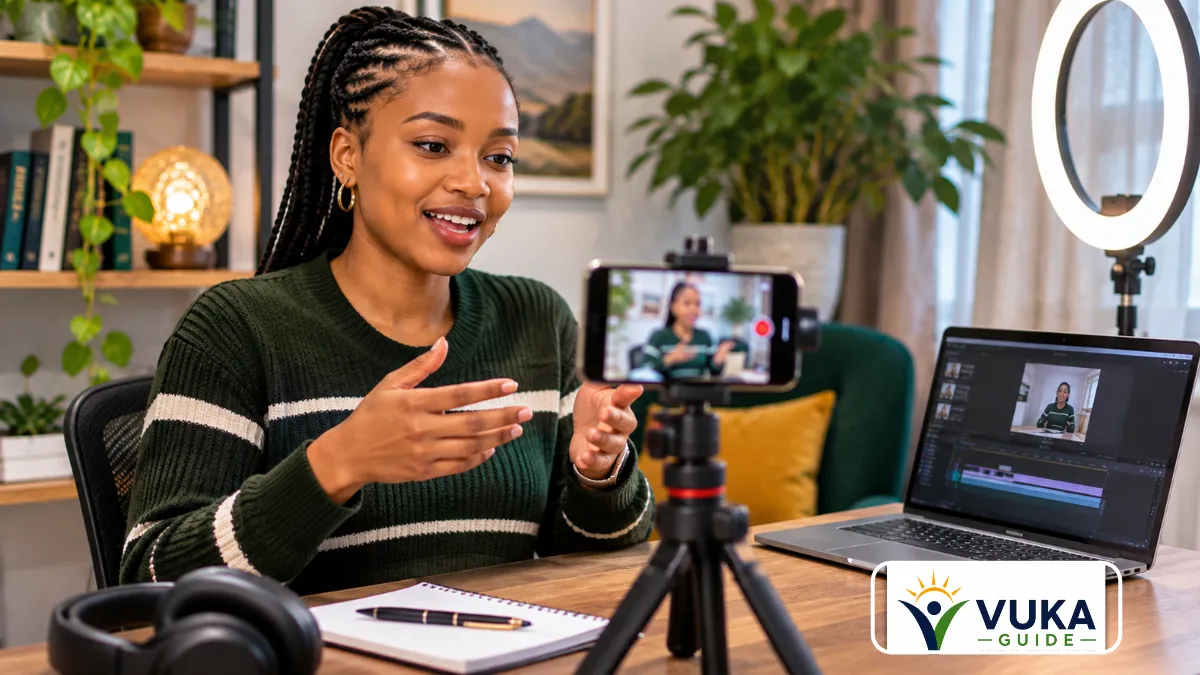
Content creation has become an opportunity for people who enjoy making videos, writing articles, taking photographs, designing graphics or sharing useful information online. South Africans can use digital platforms to build audiences, showcase their creativity and develop income opportunities.
However, earning money from content creation involves more than uploading videos or attracting followers. Creators need to understand their audience, produce valuable content, choose suitable platforms and identify ways to generate income.
There are several possible income streams, including YouTube advertising, brand partnerships, affiliate marketing, sponsored posts, commissioned content and selling digital products or creative services.
This guide explains how to approach content monetisation in South Africa, how different income models work and what creators should understand about platform eligibility, advertising disclosures and tax responsibilities.
Important: Content creation does not guarantee an income. Platform features and payment arrangements have eligibility requirements. People under 18 should involve a parent or legal guardian in any commercial arrangements, account-payment arrangements or agreements that require adult participation.
1. Choose your content niche
The first step is deciding what type of content you want to create.
A niche helps you establish a clear identity and makes it easier for audiences to understand what they can expect from your page, channel or website.
Possible content niches include:
- Education and study support
- Technology and digital skills
- Career guidance
- Beauty and lifestyle
- Food and cooking
- Travel and local experiences
- Personal finance education
- Entertainment
- Sports commentary
- Photography and creative design
- Business and entrepreneurship
Choose a subject you understand, enjoy researching or are willing to learn about consistently.
For example, a creator interested in education could publish study tips, explain career pathways, discuss bursary opportunities or share information about skills development.
A focused niche can also help potential clients and brands understand the type of audience your content serves.
2. Select the right content platform
You do not need to create content on every social media platform. Start with one main platform and choose others only when they support your content strategy.
YouTube
YouTube is suitable for creators who produce educational videos, tutorials, entertainment, reviews, commentary and other video content.
Potential income sources include:
- Advertising revenue
- YouTube Premium revenue
- Channel memberships
- Super Chat and Super Stickers
- Super Thanks
- Eligible shopping features
South Africa is included in the YouTube Partner Programme and the expanded programme’s country list.
The expanded YouTube Partner Programme provides eligible creators with earlier access to certain fan-funding and shopping features. The published entry thresholds include:
- 500 subscribers
- Three valid public uploads in the previous 90 days
- Either 3,000 valid public watch hours in the previous 12 months or three million valid public Shorts views in the previous 90 days
For advertising revenue sharing, the higher published threshold is:
- 1,000 subscribers
- Either 4,000 valid public watch hours in the previous 12 months or 10 million valid public Shorts views in the previous 90 days
Meeting the numbers does not automatically mean a channel will be approved. YouTube also reviews channels against its monetisation policies, and individual features have additional requirements.
Official information: https://support.google.com/youtube/answer/13429240
TikTok
TikTok can help creators reach audiences through short-form videos, educational content, entertainment and other creative formats.
For South African creators, TikTok has introduced TikTok One opportunities that connect eligible creators with brands.
Its South African announcement describes three routes:
- Spark Opportunity: Eligible creators can authorise brands to promote existing TikTok videos as Spark Ads. The published requirement includes at least 500 followers and registration with TikTok One.
- Creative Challenge: Creators can produce videos in response to brand briefs. The published requirement includes at least 1,000 followers and registration with TikTok One.
- Creator Led Package: Approved creator marketing agencies can invite selected creators to participate in partnerships.
These are commercial collaboration opportunities, not guaranteed payments for every creator. Campaign conditions and eligibility requirements apply.
TikTok’s general TikTok One eligibility guidance includes an age requirement of at least 18, although regional requirements may differ. Young creators should not assume that they can access these commercial features before meeting the platform’s age requirements.
Official information: https://newsroom.tiktok.com/unlocking-new-ways-for-south-african-creators-to-earn-through-tiktok-one
Instagram can be useful for creators who publish photography, Reels, lifestyle content, educational posts and visual storytelling.
Possible commercial opportunities include:
- Brand partnerships
- Sponsored posts
- Product demonstrations
- Affiliate arrangements
- Promoting a creator’s own products or services
Instagram monetisation features vary by country, account type and eligibility. Check the professional dashboard and official Meta creator information to establish which features are available to your account.
Do not assume that a feature advertised in another country is automatically available in South Africa.
3. Build an audience around useful content
An audience is important because brands, clients and potential customers want to understand who your content reaches and whether people find it valuable.
However, a large follower count is not the only measure of a creator’s value.
Focus on:
- Publishing original content
- Maintaining a consistent subject or niche
- Creating useful or entertaining material
- Understanding what your audience responds to
- Improving video, writing, photography or design skills
- Responding appropriately to audience feedback
- Following each platform’s community guidelines
Avoid buying followers, views or engagement. Artificial engagement does not demonstrate genuine audience interest and may damage your account’s credibility.
4. Create a content portfolio
A portfolio is a collection of examples that demonstrates what you can produce.
It can be useful when approaching a potential client or showing a brand what type of content you create.
Your portfolio could include:
- Three to five examples of your strongest work
- Short-form video examples
- Product demonstration samples using items you already own
- Photography or graphic design samples
- Educational articles or blog posts
- Examples of storytelling and editing
- A short introduction explaining your content niche
You do not need to wait until you have thousands of followers before developing a portfolio.
A creator who produces good-quality work for a small audience may still demonstrate useful creative skills.
5. Explore different ways to earn from content creation
There is no single way to monetise content. Different income models suit different creators and platforms.
A. Brand partnerships and sponsored content
Brands may pay creators to introduce products, demonstrate services or publish promotional content to an audience.
Examples include:
- Sponsored videos
- Product demonstrations
- Sponsored social media posts
- Brand campaigns
- Event coverage
- Long-term creator partnerships
The payment and deliverables depend on the agreement between the brand and creator.
Before accepting a partnership, understand what the brand expects, how the content may be used and what compensation has been agreed.
B. User-generated content (UGC)
User-generated content, commonly called UGC in the marketing industry, refers to content produced for a brand to use in its marketing.
A creator may produce:
- Product demonstration videos
- Short promotional videos
- Customer-style testimonials
- Lifestyle photographs
- Tutorials
- Unboxing-style content
Unlike traditional influencer marketing, a UGC creator may be paid for producing the content rather than publishing it to a large personal following.
A written agreement should explain the payment, deadlines, usage rights and whether the brand can use the content in paid advertising.
C. Affiliate marketing
Affiliate marketing allows creators to earn commissions when people make qualifying purchases through tracked links or referral codes.
For example, a creator may publish an educational technology review and include an affiliate link to a relevant product.
Possible affiliate content includes:
- Technology reviews
- Book recommendations
- Software demonstrations
- Product comparisons
- Tutorials
- Educational resource recommendations
Creators should understand the programme’s commission conditions, payment arrangements, return policies and disclosure requirements.
A commission is not guaranteed simply because someone clicks a link. The qualifying purchase and programme conditions determine whether a commission is earned.
D. YouTube advertising revenue
Creators accepted into the YouTube Partner Programme may earn a share of advertising revenue when eligible advertisements appear on their content.
YouTube also offers other monetisation features, subject to their individual requirements.
Creators should remember that advertising revenue depends on factors such as eligible views, advertising demand, audience location, content suitability and platform policies.
E. Selling digital products
Some creators develop their own digital products that solve a particular problem for their audience.
Examples include:
- Study planners
- Educational worksheets
- Design templates
- Digital guides
- Photography presets
- Original e-books
- Productivity resources
Digital products require time and effort to develop. Creators should make sure that they own or have permission to use all the material included in their products.
F. Offering creative services
Content creation skills can also be used to provide services to clients.
Possible services include:
- Video editing
- Graphic design
- Photography
- Social media content planning
- Blog writing
- Website content
- Short-form video production
This approach may be suitable for creators who have developed practical creative skills and can demonstrate their work through a portfolio.
6. Prepare a simple content monetisation plan
Once you understand the available income models, decide which ones are realistic for your content.
A simple plan should identify:
| Planning area | What to decide |
|---|---|
| Content niche | What subject will you focus on? |
| Main platform | Where will you publish most often? |
| Audience | Who do you want to reach? |
| Content format | Videos, articles, photographs or graphics? |
| Income model | Brand partnerships, services, affiliate marketing or platform revenue? |
| Portfolio | What work will demonstrate your skills? |
| Publishing routine | How frequently can you create quality content? |
Avoid trying to use every monetisation method at the same time. Start with the approach that best matches your content and available resources.
7. Approach brands and potential clients professionally
When your portfolio is ready, you can begin researching organisations that may need the type of content you produce.
A professional creator profile should explain:
- Your content niche
- The type of audience you reach
- Your content formats
- Examples of your work
- Your contact arrangements
- The services you can provide
If you are discussing a commercial arrangement, make sure the scope of work and payment conditions are clearly documented.
A written agreement should cover:
- The content required
- Number and format of deliverables
- Publication or delivery dates
- Payment amount and timing
- Content ownership and usage rights
- Whether the brand can edit or reuse the content
- Exclusivity conditions, if applicable
- Cancellation and revision arrangements
Creators under 18 should have a parent or legal guardian involved in commercial discussions and agreements. Do not share private identification, banking or contact information with unknown people who approach you online.
8. Disclose sponsored content and affiliate relationships
Audiences should be able to recognise when content is advertising.
South Africa’s Advertising Regulatory Board has social media advertising guidance that recognises identifiers such as:
- #Ad
- #Advertisement
- #Sponsored
Creators should also disclose relevant product or service exchanges when goods or services are supplied in return for media coverage.
Do not make false or exaggerated product claims simply because a brand is paying for a promotion. Only make statements that you can honestly support.
Official guidance: https://www.arb.org.za/code-file-downloads/Appendix_Social_Media_v2026-02.pdf
9. Understand tax responsibilities for South African content creators
Content creation income may have tax consequences in South Africa.
In October 2026, the South African Revenue Service (SARS) published specific guidance for social media influencers and content creators.
SARS explains that income may come from:
- Sponsored content
- Brand partnerships
- Advertising revenue
- Affiliate commissions
- Platform payments
- Subscriptions
- Digital products
- Services provided to clients
Importantly, income is not limited to cash. Products, services, travel, accommodation and other benefits received in exchange for content or promotional work may also need to be considered for tax purposes.
What records should creators keep?
SARS identifies records such as:
- Contracts and agreements
- Invoices and receipts
- Bank statements
- Platform earnings statements
- Sponsorship agreements
- Affiliate reports
- Evidence of published content
- Records of products or services received in exchange for promotional work
SARS generally requires supporting records to be retained for at least five years, subject to applicable requirements.
VAT considerations
From 1 April 2026, SARS states that compulsory VAT registration applies when the total value of taxable supplies exceeds R2.3 million in a 12-month period. Voluntary registration may be available when taxable supplies exceed R120,000, subject to the applicable requirements.
These figures relate to taxable turnover, not profit after expenses. VAT registration and the correct tax treatment depend on the nature of the creator’s activities and circumstances.
Creators should consult SARS guidance or a suitably qualified tax practitioner when they begin earning income.
Official SARS guide: https://www.sars.gov.za/guide-to-taxation-of-income-received-by-social-media-influencers-and-content-creators/
10. Understand age and payment requirements
Not every monetisation service is available to people of every age.
For example, Google states that AdSense account holders must be at least 18. For an eligible YouTube channel operated by someone under 18, an approved AdSense for YouTube account belonging to a parent or guardian over 18 may be used. Payments are made to the adult responsible for that account.
TikTok One’s general eligibility guidance also includes an age requirement of at least 18, subject to regional differences.
Young creators should:
- Check the minimum age for each platform feature.
- Never enter a false date of birth.
- Involve a parent or legal guardian where adult participation is required.
- Avoid signing agreements without appropriate adult guidance.
- Never share passwords or verification codes with people claiming to represent a brand.
- Be cautious of anyone promising guaranteed earnings or asking for upfront fees to secure a creator opportunity.
Official age information:
- Google AdSense: https://support.google.com/adsense/answer/9724
- YouTube: https://support.google.com/youtube/answer/2533300
- TikTok One: https://support.tiktok.com/en/business-and-creator/tiktok-one/tiktok-one-eligibility
A practical 30-day content creation plan
The following plan can help a beginner organise their first month of content creation. It focuses on building skills and a portfolio rather than expecting immediate income.
| Period | Main activity | Suggested outcome |
|---|---|---|
| Week 1 | Choose a niche and research your audience | A clear content direction |
| Week 2 | Create original videos, articles or graphics | Initial content samples |
| Week 3 | Publish consistently and review audience feedback | Improved content quality |
| Week 4 | Organise your portfolio and research suitable income models | A basic monetisation plan |
At the end of the month, review which content performed well, what you enjoyed creating and what skills you need to improve.
Suggested for VukaGuide
- Top Free Tech Bootcamps in South Africa: Programmes With Internship and Career Pathways
- Skills Development Opportunities for South African Youth
- Online Learning Opportunities for Unemployed Youth in South Africa
- A Beginner’s Guide to Starting Your Career in South Africa
- What Does “No Experience Required” Mean on a Job Advert?
- Language and Linguistics Study Opportunities in South Africa
- How to Apply for TVET College Admission in South Africa: A Step-by-Step Guide
- How to Find Bursaries for South African Students: A Complete Application Guide
- 5 University Courses and Career Options After Matric in South Africa
- How to Calculate Your APS Score for University Admission in South Africa
Frequently asked questions
1. Can South Africans make money from content creation?
Yes. South African creators may earn through platform monetisation, brand partnerships, sponsored content, affiliate marketing, commissioned creative work and digital products. Each income source has its own conditions.
2. Do I need thousands of followers to earn money?
Not necessarily. Some opportunities, particularly commissioned content and UGC production, focus on the quality of the work rather than the size of a creator’s audience. Platform monetisation and brand campaigns may have specific eligibility requirements.
3. Which platform is best for content monetisation in South Africa?
There is no single best platform for every creator. YouTube may suit long-form educational and entertainment videos, while TikTok and Instagram may suit short-form and visual content. Choose according to your content format and audience.
4. Is content creation income taxable in South Africa?
Income earned through content creation may be taxable. SARS explains that cash payments and certain non-cash benefits received in exchange for content or promotional services must be considered for tax purposes.
5. Can a beginner become a content creator?
Yes. Beginners can start by choosing a subject, developing content skills, publishing original work and building a portfolio. They do not need to begin with expensive equipment or a large audience.
6. Can someone under 18 monetise YouTube content?
YouTube’s AdSense for YouTube requirements state that a creator under 18 needs an approved account belonging to a parent or guardian who is over 18 to receive payments. Other platform features may have separate age restrictions.
7. Do brands pay every creator who approaches them?
No. Brands consider factors such as content quality, audience relevance, campaign requirements, budget and the creator’s suitability. Contacting a brand does not guarantee a partnership or payment.
Final thoughts
Content creation can develop into a business or a source of additional income, but it takes planning, creativity and consistency. South African creators can explore different income models, from YouTube advertising and brand partnerships to affiliate marketing and commissioned creative services.
The most practical starting point is to choose a clear niche, develop useful content, build a portfolio and learn how the relevant platforms operate.
Creators should also understand advertising disclosure requirements, protect their work, keep financial records and comply with SARS obligations. Young creators need to pay particular attention to platform age requirements and involve a parent or legal guardian whenever an arrangement requires adult participation.
Final reminder: There is no guaranteed income from content creation. Focus on developing genuine skills, producing original work and building audience trust before making financial expectations.

About
Mokoena
Puseletso Mokoena is a Vukaguide contributor who writes practical and informative content for South African job seekers, students, graduates and young professionals.
Puseletso covers employment opportunities, learnerships, internships, bursaries, education, skills development and career guidance. The focus is on making opportunity information easier to understand and helping readers navigate application requirements and processes.
Vukaguide articles by Puseletso Mokoena are written with a focus on clear, useful and factual information, with opportunity details checked against available source information where possible.
2 thoughts on “A Step-by-Step Guide to Monetising Content Creation in South Africa”