
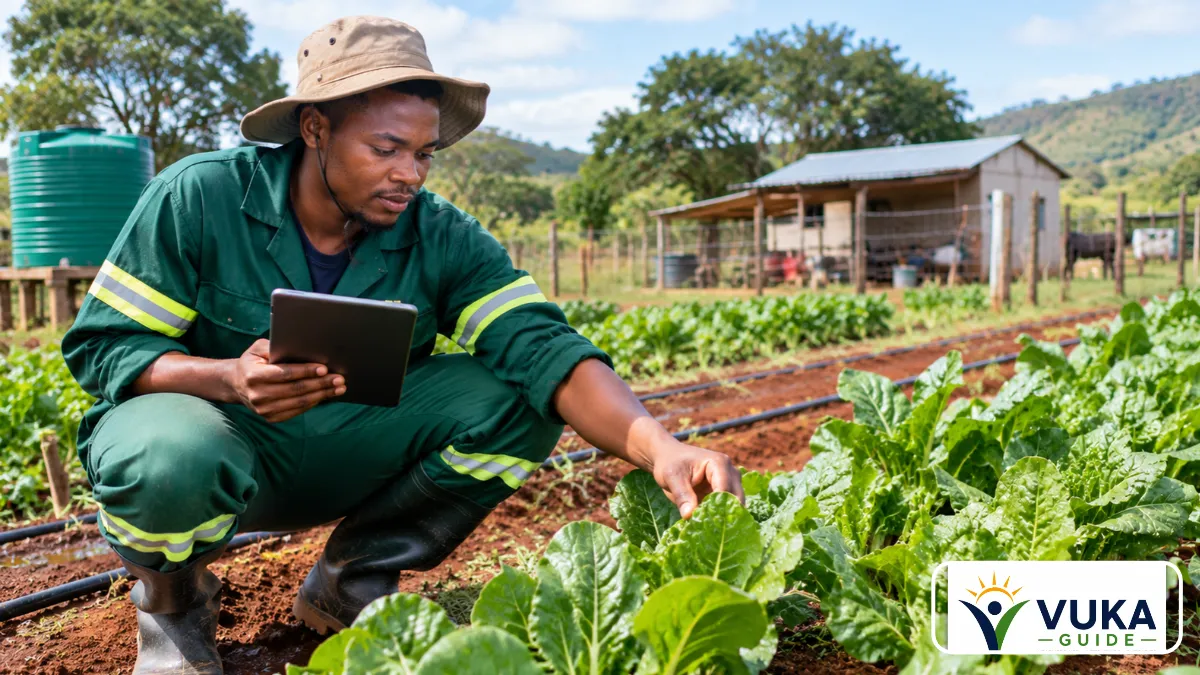
Access to agricultural land can create opportunities for young South Africans interested in farming, food production and rural enterprise development. However, having access to land is only the starting point. A successful agricultural business also requires planning, suitable resources, reliable water, practical farming knowledge and access to customers.
Young people with access to family land, communal land, leased agricultural property or land allocated through a land reform programme can explore different agribusiness opportunities. These may include vegetable production, poultry, livestock, fruit farming, beekeeping, aquaculture and agricultural value-adding activities.
There are also government support programmes and agricultural finance initiatives that may assist qualifying farmers. However, each programme has its own eligibility requirements, application process and funding conditions.
This guide explains some of the opportunities young South Africans can consider, how to prepare a farming project and where to investigate agricultural support.
1. Vegetable production
Vegetable farming is one possible starting point for young people with suitable land and access to water.
Depending on local conditions, farmers can consider producing tomatoes, spinach, cabbage, onions, chillies, green peppers and other vegetables.
Vegetables can be sold to:
- Local households and community markets.
- Informal traders and small retailers.
- Restaurants and food businesses.
- Fresh produce markets.
- Agricultural cooperatives and established buyers.
Before choosing a crop, investigate which vegetables are already in demand in the surrounding area. Consider the growing season, soil conditions, water availability, production costs and expected selling price.
Young farmers should also avoid planting large areas without first understanding their potential market. Starting with a manageable production area can help a new farming enterprise learn how to manage inputs, harvesting and sales.
2. Poultry farming
Poultry production offers another possible agricultural business opportunity.
Young entrepreneurs can investigate:
- Broiler production for meat.
- Egg production.
- Production and supply of poultry feed as a value-adding activity.
- Other poultry-related services, where suitable facilities and market demand exist.
A poultry project requires more than access to land. Farmers must consider suitable housing, ventilation, reliable water, feed costs, animal health, hygiene and access to buyers.
The business plan should calculate the cost of raising the birds and the likely income from sales. It should also consider the effect of feed-price increases and possible production losses.
Anyone planning a poultry enterprise should obtain appropriate agricultural and animal-health guidance before starting.
3. Livestock farming
Young South Africans with suitable grazing land may investigate livestock production.
Possible areas include:
- Cattle farming.
- Goat farming.
- Sheep farming.
- Pig production.
The best option depends on the size and condition of the land, grazing availability, water access, infrastructure and the local market.
Livestock farmers must plan for animal health, veterinary services, breeding, feed, fencing, shelter and security. They should also understand the costs of maintaining animals during dry periods when grazing may be limited.
A smaller, properly managed livestock project may be more realistic than attempting to establish a large herd without sufficient resources.
4. Fruit and orchard production
Young farmers with suitable soil, water and long-term access to land can investigate fruit production.
Possible crops include citrus, mangoes, avocados, bananas and other fruit varieties suited to the local climate.
Fruit farming can require substantial preparation and patience. Some crops take several years before they produce commercially useful harvests. Farmers must therefore consider the cost of establishing an orchard, maintaining trees and managing pests and diseases before expecting income.
It is also important to investigate market requirements, grading standards, packaging and transport.
For long-term crops, secure land-use rights are especially important. A farmer should not invest in permanent infrastructure or establish an orchard on land without understanding the duration and conditions of the land agreement.
5. Beekeeping and honey production
Beekeeping, also known as apiculture, is another agricultural activity worth investigating.
A suitable project may produce honey and other bee-related products, depending on the production model and market.
Before establishing a beekeeping enterprise, young farmers should receive appropriate training and understand the management, safety and environmental requirements involved.
They should also investigate whether there are established honey buyers, local retailers or agricultural cooperatives that could provide a route to market.
6. Aquaculture and fish farming
Aquaculture involves producing fish and other aquatic organisms under managed conditions.
For young people with suitable land and reliable water resources, fish farming may be an option to investigate.
However, it is not suitable for every property. A viable project needs appropriate water conditions, suitable infrastructure, fish feed, technical knowledge and access to buyers.
Water availability, water quality, operating costs and relevant environmental or water-use requirements must be assessed before investing.
7. Agricultural processing and value addition
Agribusiness does not have to end when crops or livestock are produced.
Young entrepreneurs can investigate opportunities to add value to agricultural products. Depending on the product, facilities and applicable food-safety requirements, these may include:
- Cleaning, sorting and packaging vegetables.
- Processing fruit into juice or dried products.
- Producing packaged honey.
- Packaging and distributing agricultural products.
- Processing and packaging other locally produced foods.
Value addition can help farmers reach different markets and develop additional income streams.
However, processing activities may require additional equipment, food-safety compliance, suitable premises, packaging and business approvals. These costs should be included in the business plan.
8. Government support and agricultural finance
Young farmers should investigate government agricultural support before committing to expensive equipment or production inputs.
The following are useful starting points.
Limpopo Department of Agriculture and Rural Development: Farmer Support Programme
The Limpopo Department of Agriculture and Rural Development has published its 2027/2028 Farmer Support Programme.
The published guideline advertises applications until 30 November 2026 at 16:30. Applicants must be South African citizens aged 18 or older, involved in agricultural or value-adding activities in Limpopo, and have lawful access to agricultural land.
The guideline recognises land access supported by arrangements such as a title deed, lease agreement or communal land tenure.
The programme identifies possible support areas including:
- Agricultural infrastructure development.
- Production inputs such as seeds, seedlings, fertiliser and animal feed.
- Mechanisation services and mechanisation subsidies.
- Breeding stock for certain production systems.
- Marketing activities.
- Producer and farm-worker capacity building.
The targeted commodities include poultry, vegetables, grain and industrial crops, fruit, livestock, beekeeping, rabbit farming, aquaculture and piggery.
The programme gives preference to certain groups, including youth, women, military veterans, people living with disabilities, traditional leaders and unemployed agriculture graduates participating in the department’s graduate placement programme.
Importantly, the programme does not promise applicants cash payments. The application form states that support is provided through approved arrangements, subject to screening, available funding and departmental approval.
How to apply: Obtain the official application form from the Limpopo Department of Agriculture and Rural Development. Applications must be hand-delivered to the Local Agricultural Office where the project is situated. Applicants should obtain acknowledgement of receipt.
For enquiries, contact the department on 015 294 3000 or email farmercare@agric.limpopo.gov.za.
Applicants should check the official guideline and application form carefully before submitting anything.
Agricultural Youth Fund
The Agricultural Youth Fund is a partnership between the Land Bank and the National Youth Development Agency (NYDA).
Its stated purpose is to help qualifying youth-led farming enterprises grow their agricultural businesses.
The Land Bank’s published information identifies high-value vegetables such as baby marrow, patty pans, chillies and baby spinach, as well as piquanté peppers and paprika, among the initially prioritised commodities.
The published fund structure combines a Land Bank debt contribution with an NYDA grant contribution. It is therefore important to understand that the initiative is not simply an unconditional grant.
Young farmers interested in the fund should consult the Land Bank Agricultural Youth Fund page and confirm whether applications are currently being accepted, which commodities qualify and what the latest requirements are.
Land Bank agricultural finance
The Land Bank provides finance for agricultural activities, including production, machinery, farm improvements and infrastructure development.
Its general financing information identifies requirements such as a detailed business plan, repayment affordability, creditworthiness and suitable security.
These requirements can be challenging for emerging farmers who have limited assets or credit history. Young applicants should contact the Land Bank to establish which products and options may be appropriate for their circumstances.
Visit the Land Bank website for current information.
MAFISA support
The Micro Agricultural Financial Institutions of South Africa (MAFISA) scheme is intended to improve access to financial services for smallholder producers in agriculture, forestry and fisheries.
Its published programme information describes support such as production loans for agricultural inputs and access through accredited financial intermediaries.
Because MAFISA involves loans, applicants must understand the repayment conditions and confirm the current eligibility requirements and available intermediaries with the Department of Agriculture.
More information is available through the Department of Agriculture’s development finance section.
9. What young farmers should prepare before applying
A farming idea is not the same as a funding-ready agricultural project. Applicants should prepare evidence that the project is realistic and that they have the right to use the land.
Useful preparation includes:
Proof of land access: This may include a title deed, valid lease agreement, Permission to Occupy (PTO) or relevant communal land-use documentation, depending on the programme.
A clear farming proposal: Explain what you intend to produce, why the project is suitable for the land and how the agricultural activity will operate.
A production plan: Identify the proposed crop or livestock, production cycle, inputs, infrastructure, water requirements and expected output.
A budget: Estimate the cost of seeds, fertiliser, feed, equipment, labour, transport, packaging and other operating expenses.
Market research: Identify potential buyers and investigate the prices, quantities and quality standards they require.
Relevant permissions: Some activities may require water-use authorisation or environmental approvals. Check the requirements before applying for support.
Business and identity documents: Depending on the application, you may need a certified identity document, entity registration documents, authorisation to represent an organisation and proof of farming income.
Requirements differ between programmes. Always use the official checklist for the specific funding opportunity.
10. Why market access matters
Producing agricultural goods does not automatically mean a farmer will make a profit.
A young farmer needs to know where the products will be sold before investing heavily in production.
Potential markets include:
- Local fresh produce markets.
- Independent retailers.
- Restaurants and catering businesses.
- Community markets.
- Agricultural cooperatives.
- Wholesalers and established distributors.
Farmers should speak to potential buyers about product specifications, delivery arrangements, quantities, payment terms and seasonal demand.
Keeping proper production and sales records can also help demonstrate that the enterprise is operating and has a realistic market.
11. A practical starting plan for young people with land
Young people who want to enter agriculture can take the following steps:
- Assess the land. Establish its size, soil conditions, water availability, access roads, fencing and existing infrastructure.
- Confirm the land-use arrangement. Make sure that the person or enterprise planning the project has lawful permission to use the land for the intended activity.
- Choose a suitable agricultural activity. Compare potential farming options against the available resources, skills, climate and market demand.
- Speak to agricultural advisers. Contact the relevant provincial agriculture department or local agricultural office for technical guidance.
- Research potential buyers. Identify who may purchase the products and what those buyers expect.
- Prepare a business case. Set out the project objectives, production plan, costs, market opportunities and expected financial requirements.
- Investigate support programmes. Check current government funding, agricultural finance and youth-development opportunities.
- Submit a complete application. Follow the official instructions and retain proof that the application was received.
Suggested for VukaGuide
- How to Register and Legalise Your Street Food or Spaza Business in South Africa
- 10 Low-Capital Businesses You Can Start With Under R1,000 in South Africa
- A Step-by-Step Guide to Monetising Content Creation in South Africa
- Top Free Tech Bootcamps in South Africa: Programmes With Internship and Career Pathways
- Skills Development Opportunities for South African Youth
- Online Learning Opportunities for Unemployed Youth in South Africa
- How to Choose an Accredited Course in South Africa: A Guide for Students and Job Seekers
- Short Courses That Can Help You Develop Workplace Skills in South Africa
- National Open Learning System (NOLS): Free Online Courses in South Africa
- Free Online Courses in South Africa: Where to Study for Free
Frequently asked questions
Can young South Africans start a farming business if they do not own the land?
Potentially, yes. Some programmes recognise lawful land-use arrangements such as leases and communal tenure. However, applicants must check the specific programme’s requirements and provide acceptable proof of their rights to use the land.
Which farming business is best for a young person?
There is no single best option. Vegetable production, poultry, livestock, fruit farming, beekeeping and aquaculture may all be worth investigating. The right choice depends on the land, water, climate, skills, available resources and market demand.
Does government provide free farming equipment?
Some agricultural support programmes may provide infrastructure, production inputs or mechanisation assistance. This does not mean every applicant receives equipment. Support is subject to programme rules, assessment, approval and available funding.
Can a young farmer apply for funding without a business plan?
Some programmes require a business case or business plan. Even where a detailed business plan is not compulsory, a realistic project proposal and budget can help demonstrate that the farming activity has been properly considered.
Is the Limpopo Farmer Support Programme open to applicants from other provinces?
No. The published 2027/2028 programme concerns agricultural and value-adding activities within Limpopo Province. Farmers in other provinces should contact their own provincial agriculture departments to identify relevant support opportunities.
Can someone under 18 apply independently for agricultural funding?
The Limpopo programme discussed in this guide requires individual applicants to be at least 18 years old. Other programmes may have their own age requirements. Younger learners can build agricultural knowledge and participate in suitable supervised learning activities, but should not misrepresent their age or apply in someone else’s name.
Final reminder
Access to land can provide a foundation for an agricultural enterprise, but sustainable farming depends on more than the availability of land. Young South Africans should carefully assess their resources, understand their land-use rights, investigate market demand and develop a realistic production plan before seeking finance or government support.
Those in Limpopo should take note of the advertised 30 November 2026 deadline for the department’s 2027/2028 Farmer Support Programme. Applicants should confirm the requirements directly with the department and submit complete applications through the prescribed channel.
Agriculture can create opportunities for production, entrepreneurship, employment and rural development. The strongest starting point is a farming project that matches the land, available resources and a genuine market need.

About
Mokoena
Puseletso Mokoena is a Vukaguide contributor who writes practical and informative content for South African job seekers, students, graduates and young professionals.
Puseletso covers employment opportunities, learnerships, internships, bursaries, education, skills development and career guidance. The focus is on making opportunity information easier to understand and helping readers navigate application requirements and processes.
Vukaguide articles by Puseletso Mokoena are written with a focus on clear, useful and factual information, with opportunity details checked against available source information where possible.