
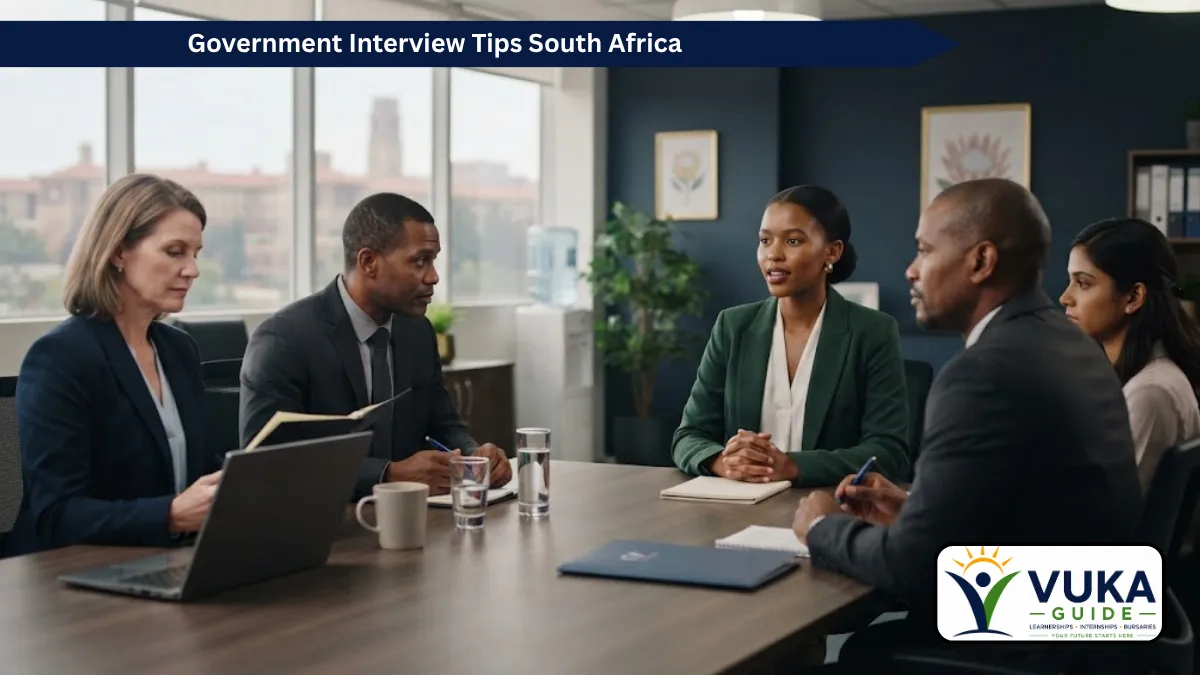
Being invited to a government job, internship, learnership or graduate programme interview is an important step, but reaching the interview stage does not guarantee selection.
Government recruitment processes can involve structured interviews where candidates are assessed against the requirements of the advertised position. Applicants therefore need to understand the role, prepare examples from their experience and communicate their answers clearly.
Whether you are applying for your first government job or already have workplace experience, proper preparation can help you approach the interview with greater confidence.
This VukaGuide guide explains how to prepare, what to take with you, questions you may encounter and mistakes to avoid.
Quick Overview
| Information | Details |
|---|---|
| Guide Topic | Government Job Interview Preparation |
| Country | South Africa |
| Suitable For | Job seekers, graduates, interns and learnership applicants |
| Interview Type | In-person, virtual or structured panel interview |
| Main Focus | Preparation, communication, role knowledge and competency-based answers |
| Key Preparation | Research the organisation, understand the advert and practise answers |
Why Government Interview Preparation Matters
A government interview is an opportunity for the employer to assess whether your knowledge, skills, experience and behaviour match the requirements of the position.
Your CV may have demonstrated that you meet the minimum requirements, but an interview allows the selection panel to explore your suitability further.
For entry-level applicants, previous employment experience may be limited. This does not mean you have nothing useful to discuss.
You can use examples from:
- University or college projects
- Previous internships
- Learnerships
- Volunteer work
- Community activities
- Student leadership
- Part-time employment
- Academic assignments
- Group projects
The important thing is to explain what you did, how you approached the situation and what you learned.
1. Study the Job Advertisement
Before the interview, read the original vacancy carefully.
Pay particular attention to:
- Job title
- Department
- Key responsibilities
- Minimum requirements
- Preferred skills
- Qualification requirements
- Technical knowledge
- Location
- Reporting responsibilities
Interview questions are often connected to the responsibilities and competencies mentioned in the advertisement.
For example, if the vacancy requires customer service, you should prepare an example demonstrating how you dealt with a difficult customer or resolved a problem.
If the position involves administration, prepare examples involving organisation, record keeping, accuracy and deadlines.
2. Research the Government Department
Do not walk into an interview without knowing which organisation you are joining.
Research:
- The department’s mandate
- Its main services
- The position you applied for
- Current programmes relevant to the department
- The responsibilities of the advertised unit
- The organisation’s official website
You do not need to memorise an entire government department’s history.
Focus on information that helps you explain why you are interested in the specific position.
3. Prepare Your Introduction
One of the first questions may be:
“Tell us about yourself.”
Avoid giving your entire life story.
A stronger answer can briefly cover:
- Your educational background.
- Relevant experience or skills.
- Why you applied for the position.
- What you hope to contribute.
For example:
“I recently completed my qualification in administration and have developed strong organisational and computer skills through academic projects and practical experience. I am interested in this position because it would allow me to apply those skills in a public-service environment while continuing to develop professionally.”
Keep the answer relevant to the position.
4. Prepare for “Why Do You Want This Job?”
This question tests your motivation.
Avoid saying only:
“I need a job.”
While finding employment may be your personal motivation, the interviewer wants to understand why you are interested in the specific role.
A stronger response connects:
- Your qualification
- Your skills
- The responsibilities
- The organisation
- Your career goals
Show that you understand what the position involves.
5. Use the STAR Method
The STAR method can help you answer competency-based questions.
S — Situation: Explain what happened.
T — Task: Describe what you needed to accomplish.
A — Action: Explain what you personally did.
R — Result: Explain the outcome.
For example, if asked about teamwork, avoid simply saying:
“I am a good team player.”
Instead, describe a real situation where you worked with others, explain your responsibility and describe the result.
This gives the panel evidence rather than just an unsupported claim.
6. Common Government Interview Questions
Prepare for questions such as:
Tell us about yourself.
Focus on your education, relevant experience, skills and interest in the position.
Why do you want to work for this department?
Show that you understand the department’s role and connect it to your career interests.
Why should we appoint you?
Discuss the skills and qualities you can bring to the position.
What are your strengths?
Choose strengths relevant to the vacancy and provide evidence.
Examples include:
- Organisation
- Communication
- Teamwork
- Problem-solving
- Attention to detail
- Computer literacy
What is your weakness?
Choose a genuine professional development area and explain what you are doing to improve it.
Avoid presenting a serious requirement of the position as your weakness.
How do you handle pressure?
Give a practical example of how you prioritised tasks and maintained accuracy under pressure.
Tell us about a time you worked in a team.
Use the STAR structure and focus on your specific contribution.
Tell us about a time you solved a problem.
Explain the problem, the action you took and the result.
How do you handle conflict?
Demonstrate professionalism, listening, communication and a focus on resolving the issue constructively.
Where do you see yourself in the next few years?
Show realistic professional development goals while demonstrating interest in building relevant experience.
7. Prepare for Ethics and Public-Service Questions
Government positions can involve questions about professionalism, confidentiality, integrity and responsible service.
You may be asked how you would respond to a situation involving:
- Confidential information
- A conflict of interest
- Unprofessional behaviour
- Pressure from another person
- An instruction you believe is inappropriate
- A member of the public requesting special treatment
The safest approach is to demonstrate professionalism and an understanding that employees should follow applicable policies, procedures and laws.
Do not suggest that you would ignore official procedures simply to help someone.
8. Prepare for Customer-Service Questions
Many government employees interact directly with members of the public.
A panel may ask:
“How would you deal with an angry member of the public?”
A good answer should demonstrate that you would:
- Remain calm
- Listen carefully
- Understand the person’s concern
- Communicate respectfully
- Explain what can and cannot be done
- Follow the relevant procedure
- Escalate the matter when necessary
Avoid becoming defensive or arguing with the person.
9. Know Your CV
Anything on your CV can potentially become an interview question.
Before the interview, review:
- Qualifications
- Employment history
- Internship experience
- Volunteer work
- Skills
- Projects
- Computer programmes you listed
- Achievements
Do not list skills you cannot explain or demonstrate.
If you claim to have advanced knowledge of a particular computer programme, be prepared to answer questions about how you use it.
10. Prepare Your Documents
If the interview instructions request documents, prepare them in advance.
Depending on the employer, you may need:
- Copy of your CV
- Identification document
- Qualifications
- Academic record
- Certificates
- Driver’s licence where relevant
- Proof of registration where applicable
- Interview invitation
Do not bring confidential documents belonging to another employer or organisation.
Follow the specific instructions provided with your interview invitation.
11. Dress Professionally
Choose clean, neat and professional clothing appropriate for the organisation and position.
You do not necessarily need expensive clothing.
The goal is to look prepared and professional.
Make sure your clothing is comfortable enough to allow you to sit through the interview without distraction.
12. Plan Your Journey
For an in-person interview, check the location before the interview day.
Plan:
- Transport
- Travel time
- Parking where applicable
- Building entrance
- Security procedures
- Interview venue
Aim to arrive early without arriving excessively early.
If the interview is online, test your:
- Internet connection
- Camera
- Microphone
- Headphones
- Device
- Meeting link
Choose a quiet location with minimal interruptions.
13. Practise Without Memorising
Practising interview answers is useful, but avoid memorising every sentence.
If you memorise a script word-for-word, you may struggle when the panel asks the question differently.
Instead, prepare key points.
For example:
Question: Why should we appoint you?
Key points:
- Relevant qualification
- Computer skills
- Communication
- Attention to detail
- Willingness to learn
- Relevant practical example
Then answer naturally.
14. Prepare Questions for the Interview Panel
At the end of the interview, you may be asked:
“Do you have any questions for us?”
Consider asking a professional question such as:
- What would the successful candidate’s main priorities be during the first few months?
- What skills are most important for success in this position?
- What does the team structure look like?
- What are the next steps in the recruitment process?
Avoid asking questions that were already clearly answered in the vacancy.
15. Common Interview Mistakes to Avoid
Avoid:
- Arriving late
- Failing to research the department
- Giving extremely long answers
- Interrupting panel members
- Speaking negatively about previous employers
- Providing dishonest information
- Reading answers from your phone
- Using slang throughout the interview
- Saying you applied only because you need money
- Failing to answer the question asked
- Claiming skills you do not have
- Ignoring instructions in the interview invitation
Professionalism matters throughout the process.
Government Interview Preparation Checklist
Before leaving for the interview, make sure you have:
- Read the complete vacancy advertisement
- Researched the department
- Reviewed your CV
- Prepared your introduction
- Practised competency-based questions
- Prepared STAR examples
- Checked the interview location
- Planned your transport
- Prepared requested documents
- Chosen professional clothing
- Prepared questions for the panel
- Checked your phone and email for interview updates
Expert Guidance — VukaGuide Editorial Team
Your goal should not be to give the “perfect” answer to every question.
Instead, focus on demonstrating that you understand the position, can communicate clearly, behave professionally and can provide evidence of your skills.
If you are a graduate with limited work experience, do not apologise repeatedly for not having years of employment history. Use relevant examples from your studies, projects, volunteering, internships or other practical experiences.
Most importantly, never invent experience.
An honest answer explaining that you have not encountered a particular situation before, followed by an explanation of how you would approach it, is better than creating a fictional example.
Frequently Asked Questions
What questions are asked in government interviews?
Questions vary by position. Common areas include your background, motivation, strengths, teamwork, problem-solving, communication, ethics and knowledge of the advertised role.
How should I answer government interview questions?
Keep answers relevant and structured. For questions asking about previous situations, the STAR method can help you provide a clear example.
What should I take to a government interview?
Take the documents requested in your interview invitation. These may include your CV, identification, qualifications and other supporting documents.
Can graduates with no work experience attend government interviews?
Yes. Where the vacancy accepts graduates or entry-level applicants, candidates can use academic projects, internships, volunteering and other relevant experiences as examples.
What should I wear to a government interview?
Wear clean, neat and professional clothing appropriate for the organisation and position.
Should I ask questions at the end of the interview?
Yes. If the panel invites questions, asking one or two thoughtful questions about the role or recruitment process can demonstrate preparation and interest.
Disclaimer
VukaGuide provides general career and interview guidance for South African job seekers. Interview procedures differ between government departments, municipalities and public entities. Always follow the specific instructions provided by the recruiting organisation.
VukaGuide is not a government department and does not participate in recruitment or selection.
Trust Signals
Written by: VukaGuide Editorial Team
Reviewed by: VukaGuide Editorial Team
Published: 18 August 2026
Last Updated: 18 August 2026
Reading Time: 6–8 minutes
Sources:
- South African Government official information
- Relevant government department recruitment information
- Official vacancy advertisements and interview instructions
Editorial Review
This article has been reviewed by the VukaGuide Editorial Team for practical relevance, clarity and accuracy. Applicants should always follow the specific instructions contained in their interview invitation or official vacancy advertisement.
Internal Suggestions
- Government Jobs
- Government Learnerships
- Government Internships
- Graduate Programmes
- CV Writing Guide
- How to Write a Government CV
- Career Advice
- Interview Questions and Answers

About
Mokoena
Puseletso Mokoena is a Vukaguide contributor who writes practical and informative content for South African job seekers, students, graduates and young professionals.
Puseletso covers employment opportunities, learnerships, internships, bursaries, education, skills development and career guidance. The focus is on making opportunity information easier to understand and helping readers navigate application requirements and processes.
Vukaguide articles by Puseletso Mokoena are written with a focus on clear, useful and factual information, with opportunity details checked against available source information where possible.