
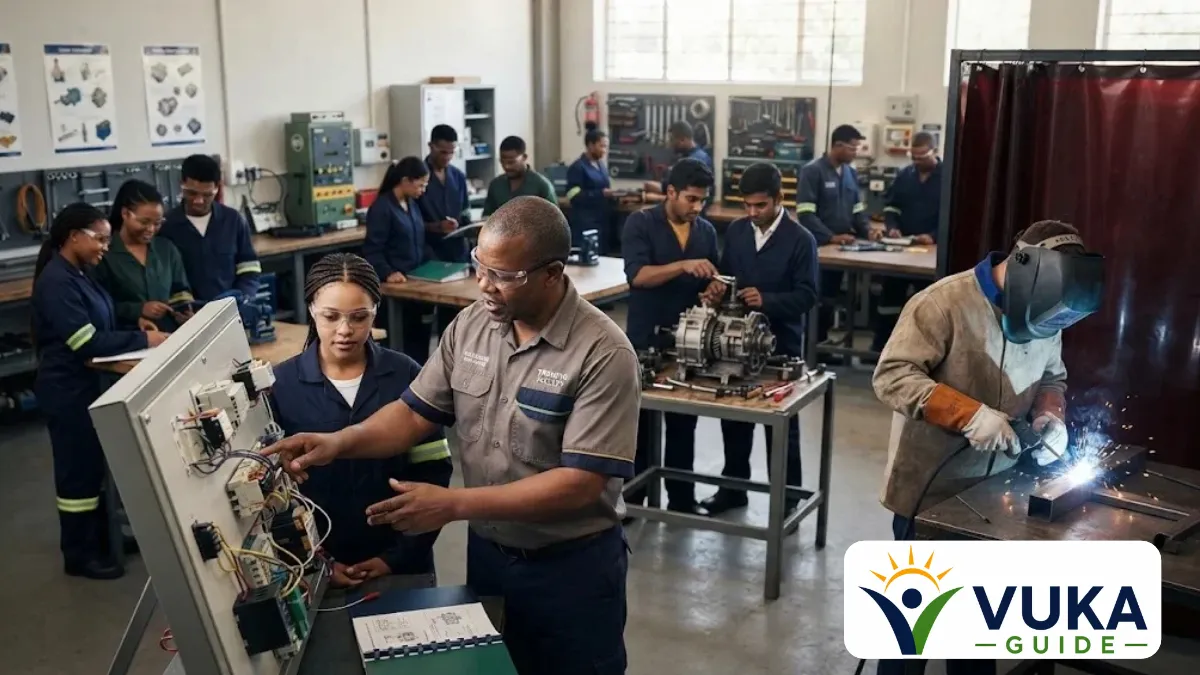
South Africans looking for practical career opportunities do not always need to follow a traditional university route. Technical and artisan careers offer another pathway, particularly for people interested in engineering, construction, manufacturing, electrical work and mechanical maintenance.
Through Sector Education and Training Authorities (SETAs), eligible learners may access skills programmes, learnerships, apprenticeships and other workplace-based training opportunities.
Some trade skills can lead to valuable employment opportunities, particularly when learners gain recognised qualifications, practical experience and the relevant professional certification.
The South African government identifies occupations such as electricians, plumbers, millwrights, welders, diesel mechanics, boilermakers and instrument technicians among the trades needed in the economy.
This guide explores 10 trade skills worth considering, how SETA-supported training works and where to look for legitimate training opportunities.
Opportunity overview
| Detail | Information |
|---|---|
| Opportunity | Technical and artisan skills development |
| Country | South Africa |
| Training support | Relevant SETAs and accredited institutions |
| Target audience | School leavers, students, graduates and eligible job seekers |
| Training types | Learnerships, apprenticeships and skills programmes |
| Qualification | Depends on the selected programme |
| Duration | Varies by trade and qualification |
| Stipend | Depends on the specific opportunity |
| Application fees | Depends on the provider; verify before paying |
| Application status | Ongoing career and training pathways, not one specific intake |
| Official information | Government and SETA websites |
What are SETAs and how do they help learners?
SETA stands for Sector Education and Training Authority.
South Africa has different SETAs responsible for supporting skills development in particular economic sectors.
Their work includes facilitating training, supporting workplace learning and helping employers develop skills within their industries.
For example:
- merSETA: Manufacturing, engineering and related industries.
- CETA: Construction and built-environment skills.
- EWSETA: Energy and water-related skills.
- MQA: Mining and minerals-related skills.
- TETA: Transport-related training.
SETA-supported training is not necessarily delivered directly by the SETA. Training may take place through approved employers, colleges and accredited skills development providers.
The Department of Higher Education and Training explains that SETAs work with other institutions to support artisan development.
Ten valuable trade skills to consider
These careers have different entry requirements and earning opportunities. The following list is based on recognised occupations and their relevance to South African industries, not a guaranteed salary ranking.
1. Electrical work and electrician training
Over 4 700 new artisans for SA | Vuk’uzenzele
Electricians work with electrical installations, equipment, maintenance and electrical systems.
Training can introduce learners to:
- Electrical principles.
- Electrical installation.
- Reading technical diagrams.
- Equipment maintenance.
- Electrical safety.
Potential career opportunities: Industrial electrician, electrical maintenance technician and electrical contractor, subject to the appropriate qualifications and registration requirements.
Relevant SETA: merSETA and other relevant skills-development structures, depending on the programme.
2. Millwright training
Millwrights work with machinery and equipment that combine mechanical and electrical systems.
Training may cover:
- Mechanical engineering principles.
- Industrial machinery.
- Equipment maintenance.
- Fault diagnosis.
- Engineering drawings.
Potential career opportunities: Industrial millwright, plant maintenance technician and engineering maintenance specialist.
Millwrights are among the occupations identified in South Africa’s official occupations-in-demand information. South African Government+1
Relevant SETA: merSETA.
3. Diesel mechanic training
Diesel mechanics maintain and repair diesel-powered vehicles and machinery.
Training may include:
- Engine systems.
- Mechanical maintenance.
- Vehicle diagnostics.
- Repair principles.
- Workshop practices.
Potential career opportunities: Diesel mechanic, fleet maintenance technician and heavy-equipment maintenance specialist.
Relevant SETA: merSETA and MQA, depending on the industry and programme.
4. Welding
Accredited Welding Courses Cape Town | MERSETA & QCTO | Swift Skills
Welding is used in manufacturing, engineering, construction and industrial fabrication.
Training may cover:
- Welding theory.
- Material identification.
- Technical drawings.
- Quality control.
- Fabrication principles.
Potential career opportunities: Welder, fabrication specialist and welding-related industrial worker.
Specialised experience and recognised qualifications can improve employment prospects.
Relevant SETA: merSETA.
5. Boilermaking
Occupational Short Courses | Welding, Electrical, Plumbing & More – CJ Artisan Training
Boilermakers work with metal structures, fabrication and industrial equipment.
Training may introduce learners to:
- Metal fabrication.
- Technical drawings.
- Measurement.
- Material preparation.
- Fabrication quality standards.
Potential career opportunities: Boilermaker, metal fabricator and industrial fabrication specialist.
Relevant SETA: merSETA.
6. Plumbing
BluLever Education | American Chamber of Commerce in South Africa
Plumbers install, maintain and repair water and drainage systems.
Training may include:
- Pipework.
- Plumbing systems.
- Water installations.
- Maintenance.
- Technical measurements.
Potential career opportunities: Qualified plumber, plumbing contractor and maintenance service provider.
Experienced and properly qualified plumbers may also explore self-employment.
Relevant SETA: CETA and other relevant accredited training arrangements.
7. Solar installation
Solar PV Mounter Course | Nepoworx Energy
Solar installation is connected to the growing renewable-energy sector.
Training pathways may introduce learners to:
- Renewable-energy principles.
- Solar photovoltaic systems.
- System components.
- Installation theory.
- Maintenance principles.
Potential career opportunities: Solar installation technician and renewable-energy service specialist, subject to the necessary qualifications and authorisations.
Relevant SETA: EWSETA.
8. Refrigeration and air-conditioning
Refrigeration and air-conditioning technicians work with cooling systems used in homes, commercial buildings and industrial facilities.
Training may cover:
- Refrigeration principles.
- Air-conditioning systems.
- Equipment maintenance.
- System components.
- Fault identification.
Potential career opportunities: HVAC technician, refrigeration technician and cooling-system maintenance specialist.
Relevant SETA: merSETA and other relevant occupational training structures.
9. Fitting and turning
Our qualifications | Designed by experts | EAL
Fitters and turners work with engineering components, machinery and precision manufacturing.
Training may cover:
- Engineering measurements.
- Metal machining.
- Technical drawings.
- Machine maintenance.
- Component manufacturing.
Potential career opportunities: Fitter and turner, machinist and mechanical engineering workshop specialist.
Relevant SETA: merSETA.
10. Instrumentation and process control
Forberg Smith | Endress+Hauser
Instrumentation technicians work with equipment used to monitor and control industrial processes.
Training may cover:
- Measurement instruments.
- Process-control principles.
- Industrial systems.
- Instrument maintenance.
- Technical fault diagnosis.
Potential career opportunities: Instrumentation technician, industrial maintenance specialist and process-control technician.
Relevant SETA: merSETA and MQA, depending on the qualification and industry.
The MQA identifies several engineering and technical occupations, including instrument mechanics, millwrights, diesel mechanics and boilermakers, in its scarce-skills information. MQA
Which trades have strong career potential?
Consider the following comparison when choosing a training direction.
| Trade | Potential employment sectors |
|---|---|
| Electrician | Construction, manufacturing, maintenance |
| Millwright | Manufacturing, mining, industrial plants |
| Diesel mechanic | Transport, mining, agriculture |
| Welder | Manufacturing, engineering, construction |
| Boilermaker | Mining, fabrication, engineering |
| Plumber | Construction, property maintenance |
| Solar installer | Renewable energy, electrical services |
| Refrigeration technician | Retail, food processing, industry |
| Fitter and turner | Engineering, manufacturing |
| Instrument technician | Mining, energy, manufacturing |
There is no universally highest-paying trade. Specialisation, experience, location, employer and qualifications all influence earning potential.
How much can qualified artisans earn?
Trade careers can offer opportunities for career progression, but it is important to distinguish between an entry-level trainee, an experienced artisan and a specialist.
Income can vary according to:
- Years of experience.
- Industry and employer.
- Technical specialisation.
- Location and working arrangements.
- Professional certification.
- Whether someone is employed or self-employed.
Important: This guide does not publish estimated salary figures as verified SETA earnings. Not specified in the available official information.
A learner should compare actual advertised vacancies and employer salary information before choosing a trade solely because of its perceived earning potential.
Who can apply for SETA-supported trade training?
Eligibility depends on the specific programme, qualification and training provider.
Potential applicants include:
- Matriculants interested in technical careers.
- TVET college students.
- Unemployed young people who meet the programme requirements.
- People with relevant engineering subjects.
- Existing workers seeking additional skills.
- Candidates with previous practical experience.
Some programmes may require Mathematics, Physical Sciences, Engineering Science or relevant technical subjects.
Others may accept different educational backgrounds.
There is no single age limit or academic requirement that applies to every SETA programme.
The National Artisan Development Support Centre explains that artisan pathways include TVET college studies, apprenticeships, learnerships and recognition of prior learning. nadsc.dhet.gov.za
What qualifications do you need?
The entry requirements depend on the selected trade.
Some common educational pathways include:
Grade 9 or equivalent
Certain introductory training pathways may accept learners with a Grade 9 education, depending on the programme.
Matric
A matric certificate can provide access to various skills-development opportunities.
N2–N6 engineering qualifications
These technical qualifications are relevant to several engineering and artisan pathways.
NCV qualifications
National Certificate (Vocational) qualifications offered by TVET colleges can provide a route into technical careers.
Applicants should always check the specific entry requirements before registering.
How to find SETA-supported training opportunities
There is no single application form for every SETA programme. Applications are advertised through different SETAs, employers and accredited training providers.
Follow these steps:
- Choose your trade: Decide whether you are interested in electrical work, mechanical engineering, plumbing, welding or another occupation.
- Identify the relevant SETA: Research which SETA supports training in your chosen industry.
- Visit the official website: Look for learnerships, apprenticeships, skills programmes and training announcements.
- Check the training provider: Confirm that the provider is accredited to offer the particular qualification.
- Read the requirements: Check educational qualifications, age restrictions, location and application deadlines.
- Prepare your documents: Follow the specific advertisement’s document checklist.
- Submit your application: Use the official application channel stated in the announcement.
Official websites to explore
merSETA
Manufacturing, engineering and related services training.Visit merSETA
CETA
Construction education and training.Visit CETA
EWSETA
Energy and water sector skills development.Visit EWSETA
MQA
Mining and minerals sector training.Visit MQA
TETA
Transport sector skills development.Visit TETA
Documents to prepare
The exact documents depend on the training opportunity.
The following is a general preparation checklist, not a claim that every programme requires all these documents.
Document preparation checklist
0/7 readyUpdated CV, if requestedCertified copy of South African ID, if requestedMatric certificate or latest school resultsTVET college or university qualifications, where applicableProof of residence, if requestedRelevant academic transcriptsAny additional documents specified in the advertisement
Reset checklist
Never send sensitive personal documents to unverified recruiters or training providers.
How long does artisan training take?
Training duration depends on the trade, qualification and learning pathway.
Artisan development normally combines different learning components:
- Theoretical learning.
- Practical skills development.
- Supervised workplace experience.
- Assessments and phase tests.
- A final trade test where required.
The government describes the traditional artisan apprenticeship pathway as combining theoretical training, practical training and workplace mentorship, followed by a trade test. South African Government+1
A short skills course should not automatically be treated as equivalent to a completed artisan qualification.
How to check whether a training provider is legitimate
This is one of the most important steps before enrolling.
The Quality Council for Trades and Occupations (QCTO) oversees accreditation of skills development providers offering occupational qualifications and relevant programmes.
Before registering:
- Ask for the provider’s accreditation details.
- Check whether accreditation covers your particular qualification.
- Confirm that the qualification is registered and recognised.
- Check the relevant assessment and trade-testing arrangements.
- Request written information about fees and funding.
The QCTO provides information about accredited training providers and assessment centres. qcto.org.za+1QCTO learner information and provider verification
Application tips for aspiring artisans
To improve your preparation:
- Develop your Mathematics and technical problem-solving skills.
- Take relevant school subjects seriously.
- Research different trades before selecting one.
- Keep your academic documents organised.
- Build basic computer and communication skills.
- Follow official recruitment announcements.
- Apply only when you meet the advertised requirements.
- Ask questions about practical training and workplace experience.
Remember that a good qualification and practical competence are important, but neither guarantees immediate employment.
Common mistakes to avoid
Applicants should avoid:
- Assuming every SETA programme is fully funded.
- Paying unverified individuals for supposed training placements.
- Registering with unaccredited institutions.
- Confusing a short course with an artisan qualification.
- Ignoring the academic requirements.
- Submitting incomplete applications.
- Believing that every learnership includes a stipend.
- Assuming that completing training guarantees a job.
What happens after completing the training?
The next step depends on the qualification.
Possible career pathways include:
- Applying for entry-level technical positions.
- Pursuing additional occupational qualifications.
- Gaining further supervised workplace experience.
- Completing the relevant trade test.
- Building experience towards specialist positions.
- Exploring self-employment where properly qualified and authorised.
For listed trades, the trade-test process is an important part of becoming a recognised artisan. The QCTO provides guidance on obtaining trade certificates and finding accredited trade-test centres.
Suggested for VukaGuide
- The Complete List of Zero-Rated Websites and Apps for SA Job Seekers
- 2027 TVET College Applications in South Africa: Which Colleges Are Open, Courses and How to Apply
- TVET Colleges That Accept Grade 9 in South Africa: Courses, Requirements and How to Apply
- 10 Legitimate Learnerships and Trade Skills You Can Start With Grade 9–11
- How to Apply for NSFAS Funding in South Africa
- Why Your SA Youth or SETA Application Never Gets a Reply (And How to Fix Your Profile)
- How to Write a CV With No Experience: A Complete Guide for First-Time Job Seekers
- How Rural Students Can Find and Apply for Bursaries in South Africa
Frequently asked questions
1. Can I learn a trade through SETA without going to university?
Yes. SETA-supported learnerships and apprenticeships can provide alternative vocational and occupational training pathways.
2. Which SETA is best for artisan training?
There is no single best SETA. The appropriate SETA depends on your chosen occupation and industry.
3. Can unemployed youth apply?
Some programmes accept unemployed applicants. Eligibility depends on the advertised opportunity.
4. Do SETA programmes pay a stipend?
Some workplace-based programmes offer stipends, but payment is not guaranteed across all SETA-supported training.
5. Can I become an electrician through SETA?
Electrical training is available through relevant occupational and artisan-development pathways. You must complete the appropriate recognised training and meet the requirements for the relevant certification.
6. Which trade is best for starting a business?
Plumbing, electrical services, welding and refrigeration may offer self-employment opportunities. However, business success depends on qualifications, experience, legal requirements, equipment and customer demand.
7. Does SETA training guarantee employment?
No. Training can improve skills and employability, but employment depends on available vacancies, experience and employer selection.
8. Can school leavers pursue artisan careers?
Yes. School leavers can investigate suitable TVET, learnership and apprenticeship pathways, subject to the relevant entry requirements and age restrictions.
Is learning a trade worth considering?
For South Africans who enjoy practical work, technical problem-solving and working with equipment, artisan training can provide a worthwhile career direction.
Trades such as electrical work, millwrighting, plumbing, diesel mechanics and instrumentation offer pathways into industries that need specialised technical skills.
However, prospective learners should consider the full training journey rather than focusing only on potential earnings.
The strongest long-term opportunity comes from combining recognised qualifications, practical experience, professional development and a commitment to quality work.
Final reminder
South Africans interested in artisan careers should start by identifying the trade they want to pursue and researching the relevant SETA-supported training pathways.
Always verify the training provider, qualification, funding arrangements and application requirements before registering.
Do not assume that every training opportunity is free, paid or guaranteed to lead to employment.
A recognised skill, practical experience and the right qualifications can help build a stronger foundation for a technical career.
Official research sources
The following sources support the article’s career and training information:
- South African Government – Artisan Training Information.
- 2024 National List of Occupations in High Demand.
- Mining Qualifications Authority – Scarce Skills.
- QCTO – Skills Development Provider Accreditation.
- National Artisan Development – Pathways to Becoming an Artisan.
- DHET – Statistics on Post-School Education and Training 2024

About
Mokoena
Puseletso Mokoena is a Vukaguide contributor who writes practical and informative content for South African job seekers, students, graduates and young professionals.
Puseletso covers employment opportunities, learnerships, internships, bursaries, education, skills development and career guidance. The focus is on making opportunity information easier to understand and helping readers navigate application requirements and processes.
Vukaguide articles by Puseletso Mokoena are written with a focus on clear, useful and factual information, with opportunity details checked against available source information where possible.