
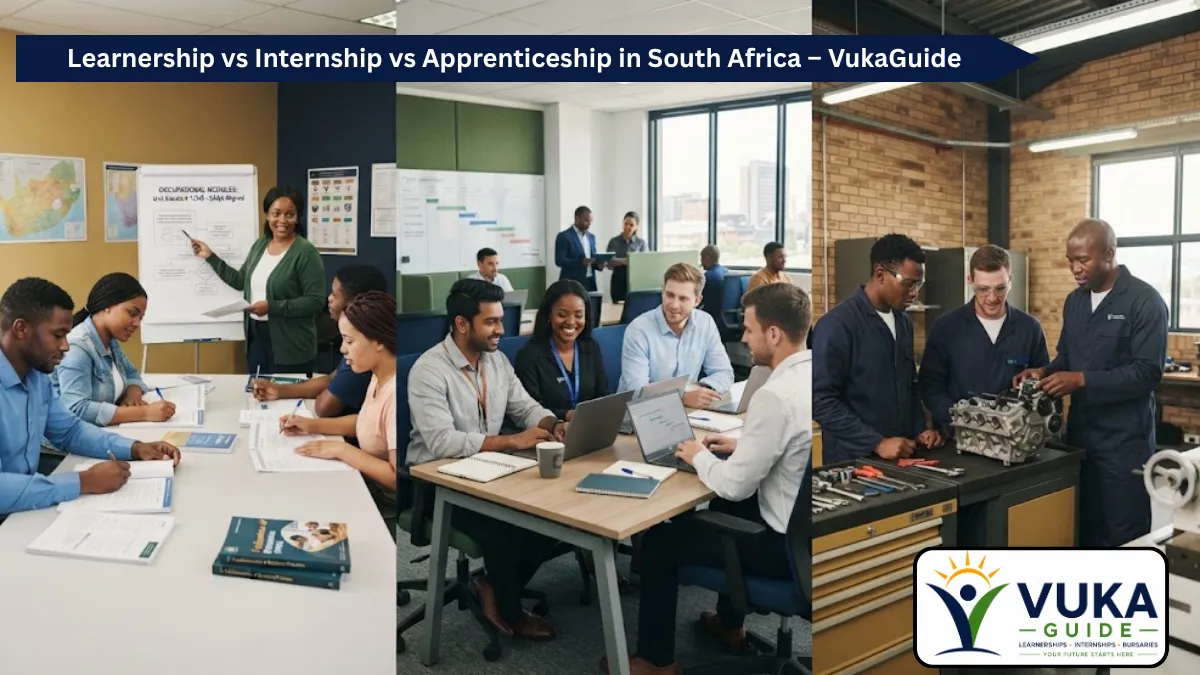
For young South Africans looking for their first opportunity after matric, the terms learnership, internship and apprenticeship can sometimes be confusing.
All three can provide valuable workplace experience, training and a pathway into employment, but they are not the same. They can differ in their purpose, entry requirements, training structure, qualifications and the types of careers they lead to.
Understanding the difference can help you apply for opportunities that match your education, career goals and current level of experience.
Learnership vs Internship vs Apprenticeship at a Glance
| Feature | Learnership | Internship | Apprenticeship |
|---|---|---|---|
| Main purpose | Combine structured learning with workplace experience | Provide practical workplace experience | Develop practical and technical trade skills |
| Typical applicants | Often unemployed youth and entry-level candidates | Students, graduates and entry-level candidates | People pursuing skilled trades |
| Qualification | Usually linked to a recognised occupational qualification | Depends on the programme | Trade qualification pathway |
| Workplace training | Yes | Yes | Yes |
| Classroom/theory component | Usually | Depends on programme | Yes |
| Stipend/salary | May be provided | May be provided | May be provided |
| Common fields | Business, banking, retail, IT, insurance and others | Finance, HR, IT, marketing, engineering and others | Electrical, plumbing, welding, fitting and other trades |
| Main outcome | Occupational skills and qualification | Work experience and professional exposure | Trade skills and progression toward trade certification |
What Is a Learnership?
A learnership combines structured theoretical learning with practical workplace experience.
Learnerships are particularly common in South Africa and can be aimed at unemployed people, school leavers, graduates or employees, depending on the programme.
A learner normally spends part of the programme completing structured training and part gaining practical experience in a workplace.
Learnerships can be available in many sectors, including:
- Banking
- Insurance
- Retail
- Information technology
- Business administration
- Contact centres
- Manufacturing
- Healthcare
- Government
- Hospitality
A learnership can be useful for someone who wants to gain an occupational qualification while developing workplace skills.
Who Can Apply for a Learnership?
Requirements depend on the specific programme.
Some learnerships require only Grade 12, while others require a relevant certificate, diploma or degree.
Typical requirements may include:
- South African citizenship
- Grade 12
- A relevant qualification
- A specified age range, where applicable
- Computer literacy
- Communication skills
Always check the individual advert because requirements differ between employers and programmes.
Do Learnerships Pay a Stipend?
Many learnerships provide a monthly stipend, but the amount varies.
A stipend is not necessarily the same as a permanent employee salary. The official opportunity should clearly state whether a stipend is offered and how much successful learners will receive.
What Is an Internship?
An internship is generally designed to provide practical workplace experience related to a person’s studies or career field.
Internships are common among students, recent graduates and people entering professional careers.
For example, an organisation may recruit graduates for internships in:
- Finance
- Human Resources
- Marketing
- Information Technology
- Supply Chain
- Engineering
- Communications
- Accounting
- Administration
- Data and analytics
An internship can help a candidate understand how their academic knowledge is applied in a real workplace.
Who Can Apply for an Internship?
This depends heavily on the programme.
Some internships are aimed at students who need workplace exposure to complete their studies. Others are specifically designed for graduates who have already completed a diploma or degree.
A graduate internship may therefore require:
- A completed diploma or degree
- A specific field of study
- South African citizenship
- Computer literacy
- Good communication skills
- No previous formal experience, depending on the programme
Some internships have strict graduation dates, age limits or other eligibility conditions.
Do Internships Pay?
Some internships provide a stipend or salary, while others may have different arrangements.
Never assume that an internship is paid simply because it is called an internship. Check the official vacancy or programme information for the compensation details.
What Is an Apprenticeship?
An apprenticeship is a structured training pathway focused primarily on developing practical skills in a trade or technical occupation.
Apprenticeships are commonly associated with skilled trades such as:
- Electrical work
- Fitting and turning
- Welding
- Plumbing
- Automotive repair
- Millwright work
- Boilermaking
- Mechanical trades
An apprentice learns through a combination of practical workplace training and theoretical learning.
The goal is to develop the technical competence required for a skilled occupation.
Who Should Consider an Apprenticeship?
An apprenticeship can be particularly suitable for someone who enjoys practical, technical or hands-on work.
Depending on the trade and training provider, entry requirements can include Grade 9, Grade 12, N-level subjects, mathematics, physical science or other relevant qualifications.
Requirements vary significantly between trades and employers.
If you are interested in becoming a qualified artisan, investigate the specific apprenticeship and trade requirements before applying.
Learnership vs Internship
The biggest difference is usually the purpose and structure of the programme.
A learnership is generally structured around occupational learning combined with workplace experience and can lead to a recognised qualification.
An internship is primarily focused on gaining practical workplace exposure in a particular professional field.
For example, a Grade 12 school leaver might apply for a business administration learnership, while a graduate with a degree in accounting might apply for an accounting internship.
However, there is some overlap. The exact structure depends on the employer, training provider and programme.
Learnership vs Apprenticeship
Both can combine learning with practical workplace experience, but they are generally associated with different types of career pathways.
Learnerships can cover a broad range of occupations and industries, including office-based and service-sector roles.
Apprenticeships are more strongly associated with technical trades and artisan development.
If your goal is to become an electrician, plumber, welder, mechanic or another skilled artisan, an apprenticeship may be the more relevant pathway.
If you are interested in banking, retail, administration, insurance, IT support or other occupational fields, a learnership may be more relevant.
Internship vs Apprenticeship
An internship is commonly associated with professional, academic or corporate career paths.
An apprenticeship is generally focused on developing technical and practical trade skills.
For example:
Internship:
A graduate with a degree in Human Resources gains workplace experience in an HR department.
Apprenticeship:
A trainee develops practical and theoretical skills in a technical trade such as electrical work or fitting.
Both can provide valuable experience, but they lead toward different types of careers.
Which One Is Best After Grade 12?
There is no single option that is best for everyone.
Your choice should depend on your career goals, qualifications and interests.
Consider a Learnership if:
- You have Grade 12 and want workplace experience.
- You want to earn a recognised occupational qualification.
- You are interested in business, retail, banking, insurance, IT or other occupational areas.
- You want structured training combined with workplace exposure.
Consider an Internship if:
- You are studying or have recently graduated.
- You want practical experience related to your qualification.
- You are targeting a professional or corporate career.
- You want to strengthen your CV before applying for permanent positions.
Consider an Apprenticeship if:
- You enjoy practical and technical work.
- You want to pursue a skilled trade.
- You are interested in becoming an artisan.
- You prefer learning through practical workplace training as well as theory.
Can a Learnership, Internship or Apprenticeship Lead to a Permanent Job?
It can, but none of these programmes should automatically be treated as a guaranteed permanent job.
An employer may retain successful participants when permanent vacancies are available, but this depends on the organisation, performance, business needs and available positions.
The safest approach is to view these opportunities as ways to build:
- Work experience
- Technical skills
- Professional networks
- Industry knowledge
- Confidence
- A stronger CV
Even when a programme does not result in permanent employment, the experience can help you compete for future opportunities.
What Should You Look for Before Applying?
Before applying for any learnership, internship or apprenticeship, carefully check:
- Employer or training provider
- Programme title
- Qualification or training offered
- Duration
- Location
- Minimum requirements
- Age requirement, if applicable
- Stipend or salary
- Required documents
- Closing date
- Application method
Most importantly, make sure you understand what you will actually be trained to do.
Do not apply simply because an opportunity advertises a stipend. Consider whether the skills and experience match your longer-term career plans.
Beware of Recruitment Scams
Legitimate employers and training providers should provide clear information about the opportunity and application process.
Be cautious if someone asks you to pay money simply to secure a job, learnership, internship or apprenticeship.
Never send sensitive personal information to an unknown person or unofficial application channel without first verifying the opportunity.
Where possible, apply through the employer’s official careers website or the official application portal identified in the recruitment notice.
Frequently Asked Questions
Is a learnership the same as an internship?
No. A learnership generally combines structured occupational learning with workplace experience, while an internship is primarily focused on practical workplace exposure. The exact structure varies by programme.
Is an apprenticeship only for people with Grade 12?
Not necessarily. Entry requirements vary according to the trade, employer and training programme. Some opportunities may require specific school subjects or N-level qualifications.
Do all learnerships pay a stipend?
No. Payment arrangements vary between programmes. Always check the official opportunity for the stated stipend or compensation.
Do internships lead to permanent employment?
They can sometimes lead to permanent opportunities, but employment is not guaranteed unless the employer specifically states that a permanent position will follow.
Which option is better for unemployed youth?
It depends on your career goals and qualifications. A learnership may suit someone seeking structured occupational training, an internship may suit a student or graduate seeking professional experience, while an apprenticeship may be appropriate for someone pursuing a skilled trade.
Can I apply for all three?
Yes, provided you meet the eligibility requirements for each opportunity. Applying for several suitable opportunities can increase your chances of finding a pathway into work or further training.
VukaGuide Editorial Guidance
Do not choose between a learnership, internship and apprenticeship based only on the advertised stipend.
Instead, ask:
What will I learn?
What qualification or skills will I gain?
Will the experience be relevant to my career goal?
What can I do after completing the programme?
A programme that gives you relevant skills and meaningful workplace experience can be valuable even if it does not immediately result in permanent employment.
For young South Africans, these pathways can provide important bridges between education and the world of work.
Final Advice
Learnerships, internships and apprenticeships all offer different routes into workplace experience and skills development.
A learnership is generally focused on structured occupational learning combined with workplace experience.
An internship is generally focused on gaining practical experience in a professional or career-related environment.
An apprenticeship is generally focused on developing practical and technical skills in a skilled trade.
Before applying, read the full opportunity carefully, confirm the requirements and use the official application channel.
The right choice is the one that matches your current qualifications, interests and long-term career direction.
Disclaimer
VukaGuide provides general career and opportunity information for educational purposes. Programme structures, eligibility requirements, stipends, qualifications and application procedures can vary between organisations and may change.
Always verify the latest information through the relevant employer, training provider or official institution before applying.
VukaGuide is not the recruiting organisation and does not charge application fees.
Trust Signals
Written by: VukaGuide Editorial Team
Reviewed by: VukaGuide Editorial Team
Published: 16 August 2026
Last Updated: 16 August 2026
Reading Time: 6–8 min read
Sources:
- Official employer recruitment pages
- Official training provider information
- South African education and skills-development information
- Official programme and qualification information
Editorial Review:
This article has been reviewed for clarity and accuracy in accordance with the VukaGuide Editorial Policy.
Internal Suggestions
- Latest Learnerships
- Latest Internships
- Apprenticeships
- Grade 12 Opportunities
- Graduate Programmes
- Bursaries
- CV Writing Guide
- Interview Tips

The Vukaguide Editorial Team is dedicated to researching and publishing reliable information about South African learnerships, internships, bursaries, graduate programmes, apprenticeships, scholarships, and career opportunities.
Our content is created through careful research of official announcements, government publications, educational institutions, and employer career portals.
We regularly review published articles to keep information current and encourage readers to verify application details through the official organisation before applying.
Our goal is to help South Africans access trustworthy information that supports their education, skills development, and career growth.